

6 inch HDPE pipe fittings are key connecting components in 6-inch (DN150) HDPE pipe systems. They have the advantages of corrosion resistance, impact resistance, and long life, and are widely used in municipal, industrial, and agricultural fields. HDPE pipe fittings are connected by hot melting or electric melting to form a leak-free, integrated pipeline network.
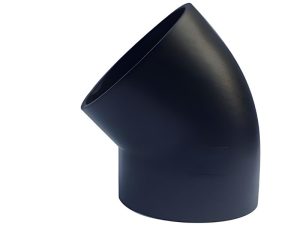
Main types of 6 inch HDPE pipe fittings
1. Classification by connection method
| Type | Characteristics | Applicable Scenarios |
| Hot-melt Fittings | Connect by heating the pipe and fitting to fuse together; high connection strength | High-pressure water supply, gas transportation |
| Electro-fusion Fittings | Built-in resistance wire heats up when powered, enabling easy connection | Emergency repairs, confined space operations |
| Mechanical Fittings | Use flanges, clamps, etc. for mechanical fixing; detachable | Temporary pipelines, frequent maintenance scenarios |
2. Classification by function
(1) Steering fittings
90° elbow: changes the direction of the pipe by 90°, divided into long radius (LR) and short radius (SR)
Long radius elbow: small flow resistance, suitable for high-pressure systems
Short radius elbow: saves space, but has large pressure loss
45° elbow: used for smooth steering and reducing water hammer effect
(2) Branch fittings
Tee (equal diameter/reducing diameter): realize fluid diversion
Equal diameter tee: main pipe and branch pipe have the same diameter (such as 6″×6″×6″)
Reducing tee: branch pipe size is smaller (such as 6″×6″×4″)
Cross: used for complex diversion systems
(3) Variable diameter fittings
Concentric reducer: center line aligned, used for vertical pipes
Eccentric reducer: one side is flush to prevent gas accumulation
(4) End fittings
Flange adapter: connects HDPE pipe to metal valve/equipment
Cap: seals the end of the pipe

Core advantages
1. Material properties
Chemical corrosion resistance: can resist acid, alkali, salt and most organic solvents
Strong impact resistance: -40℃ still maintains toughness, suitable for cold areas
Long service life: design life ≥50 years, much higher than metal pipes
2. Installation advantages
Light weight: 6-inch HDPE elbow weighs only 1/8 of the same specification steel elbow
No leakage risk: hot melt connection forms a molecular bond to prevent interface leakage
Fast construction speed: single-point operation time of electric fusion connection <15 minutes
3. Economical
Low maintenance cost: no anti-corrosion treatment is required, reducing the cost of the entire life cycle
Excellent hydraulic performance: smooth inner wall (roughness coefficient 0.009), reducing pumping energy consumption

Typical application scenarios
1. Municipal engineering
Water supply network: Tees and elbows are used to distribute water flow
Sewage system: Use reinforced pipes to deal with sedimentation problems
2. Industrial field
| Industry | Common Fittings | Special Requirements |
| Chemical | Flanged tees, reducer pipes | Resistant to hydrofluoric acid and other special materials |
| Mining | Wear-resistant elbows | Lined with ceramic or polyurethane |
| Power | Cable protection fittings | Flame retardant additives |
3. Agricultural irrigation
Drip irrigation system: use small diverter (6″ to 1″ multi-head outlet)
Drainage network: 45° elbow to reduce sediment deposition

Installation technical points
1. Hot melt connection steps
Cutting alignment: use a special pipe cutter to ensure the verticality of the end face (deviation <1°)
Heating plate treatment: temperature set to 210±5℃, heating time adjusted according to wall thickness (about 120 seconds for 6-inch pipe)
Butt pressurization: melting pressure 0.15-0.3MPa, keep fixed during cooling
2. Precautions for electric fusion connection
Surface treatment: scrape off the oxide layer (depth 0.1-0.2mm)
Voltage control: adjust according to the resistance value of the pipe fitting (usually 39.5±0.5V)
Cooling time: ≥30 minutes before pressure test
3. Quality inspection method
Visual inspection: the melt is evenly surrounded by the interface
Pressure test: 1.5 times the working pressure for 4 hours
Ultrasonic detection: check for internal fusion defects

Selection recommendations
Pressure level matching: PN10 (1MPa) or PN16 (1.6MPa)
Environmental adaptability: UV-resistant pipe fittings containing 2.5% carbon black should be selected for outdoor use
Economic balance: When purchasing in large quantities, the cost of hot-melt pipe fittings is 30-40% lower than that of electric fusion
Case reference: A water supply renovation project in a coastal city uses a 6-inch HDPE Electrofusion Tee, which increases construction efficiency by 50% and reduces the leakage rate of the pipe network from 18% to less than 3%.


