

With the increasing demands for safety and durability in modern water supply systems, HDPE (High Density Polyethylene) pipe fittings have become essential connecting components widely used in drinking water projects. So, is HDPE safe for drinking water? Will it affect water quality? This article will comprehensively introduce the safety of HDPE pipe fittings in drinking water systems from the perspectives of material safety, hygiene certification, performance advantages, and practical applications.
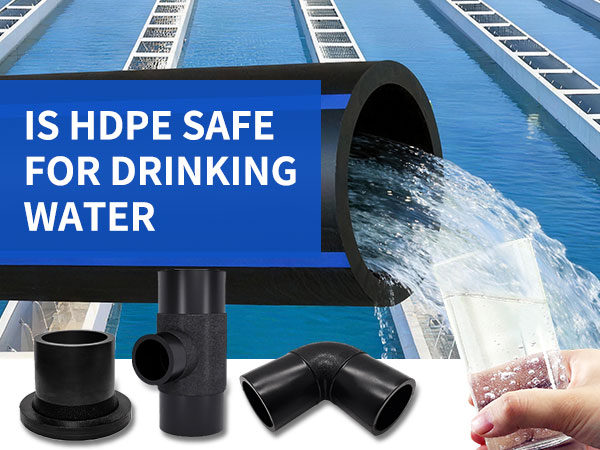
What are HDPE pipe fittings?
HDPE pipe fittings are pipe connection components made of high-density polyethylene material, mainly used to connect HDPE pipes to form a complete water transmission system.
Common HDPE pipe fittings include:
HDPE elbows
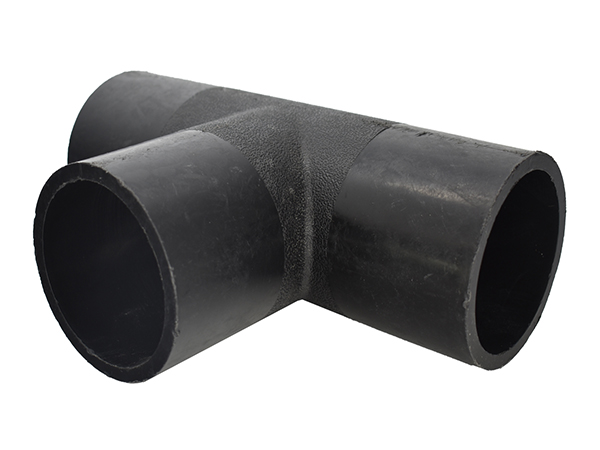
HDPE tees
HDPE couplings
HDPE flanges
HDPE reducers. These fittings form a sealed system with HDPE pipes through heat fusion, electrofusion, or mechanical connections.
In drinking water projects, fittings are just as important as pipes, as the connection points are a critical part of the entire system.
Is HDPE safe for drinking water?
The answer is: Yes, and it is widely recognized globally.
HDPE pipe fittings are specifically designed for drinking water systems and meet stringent hygiene and safety standards.
The reasons are as follows:
1. HDPE material itself is non-toxic.
HDPE is a food-grade safe material with the following characteristics:
Non-toxic and odorless.
HDPE does not release harmful substances and will not pollute water quality.
Free of heavy metals.
Unlike some metallic materials that may contain:
Lead, cadmium, mercury.
HDPE is completely free of these harmful elements.
Widely used in the food industry.
HDPE is commonly used in:
Beverage bottles,
Milk bottles,
Food packaging.
Since it can come into direct contact with food, it is naturally suitable for drinking water as well.

2. Will Not Affect the Taste and Odor of Water
High-quality HDPE pipe fittings will not:
Change the taste of water
Generate odors
Affect water quality
This is crucial for drinking water systems.
HDPE material has extremely high chemical stability and will not react with water.
3. Complies with International Drinking Water Safety Certifications
HDPE pipe fittings used for drinking water typically meet the following international standards:
NSF Certification
NSF is one of the world’s most authoritative drinking water safety certifications.
NSF certification proves:
The product is safe for use in drinking water systems.
WRAS Certification
WRAS is the UK’s drinking water safety certification.
Ensuring that the product will not contaminate drinking water.
ISO Certification
For example:
ISO 4427 This standard is specifically for HDPE piping systems used in drinking water.
FDA Certification
US Food and Drug Administration certification, proving that the material is safe for food contact.

4. HDPE pipe fittings do not corrode. Traditional metal pipe fittings suffer from the following problems:
Rusting
Corrosion
Water pollution.
HDPE pipe fittings, on the other hand:
Do not rust
Do not corrode
Do not produce pollutants
Ensuring clean and safe drinking water.
5. HDPE pipe fittings offer safe and leak-free connections.
HDPE pipe fittings typically use:
Thermofusion connection: Heating fuses the pipe and fitting into a single unit.
Advantages:
Seamless connection
Zero risk of leakage
No pollution. This is one of the safest connection methods for drinking water systems.
Electrofusion connection: Electrofusion fittings provide:
Excellent sealing
Reliable installation
After connection, the entire system forms a complete sealed structure.
Does not pollute water.
6. HDPE pipe fittings have smooth inner walls, preventing bacterial growth.
HDPE pipe fittings have an inner wall that is:
Extremely smooth;
Not prone to scaling.
Advantages:
Reduces bacterial growth;
Maintains clean water quality.
In contrast, metal pipe fittings are more prone to:
Rusting;
Scale buildup;
Bacterial growth.
7. Long service life and long-term safety.
HDPE pipe fittings have a service life of:
Up to 50 years or more.
Throughout their service life:
Does not release harmful substances;
Does not pollute water;
Long-term safety and reliability.
8. HDPE pipe fittings are widely used in global drinking water systems.
HDPE pipe fittings are widely used in:
Municipal water supply systems;
Rural drinking water projects;
Building water supply systems;
Underground water supply systems. A large number of drinking water projects worldwide use HDPE systems.
For example:
Urban water supply networks;
Underground water supply projects.
9. HDPE pipe fittings are safer than other materials.
Comparison with other pipe fitting materials:
| Material | Safety | Corrosion Resistance | Service Life |
| HDPE | Very safe | Non-corrosive | More than 50 years |
| PVC | Safe | Non-corrosive | 30–50 years |
| Steel Pipe | May corrode | Corrosive | Shorter |
| Cast Iron | Easily corroded | Corrosive | Medium |
HDPE is one of the safest materials.
10. HDPE Pipe Fittings: Environmentally Friendly and Safe
HDPE has environmental advantages:
Recyclable
Pollution-free
Environmentally friendly production process
Does not harm the environment.
HDPE pipe fittings are perfectly suitable for drinking water systems.
In summary, HDPE pipe fittings are among the safest fittings for drinking water systems because:
Non-toxic and odorless
Free of heavy metals
Does not pollute water quality
Does not corrode
Safe connections
Long service life
Complies with international certifications.
Therefore, HDPE pipe fittings are widely used in drinking water projects worldwide.
For any drinking water transportation project, choosing high-quality HDPE pipe fittings is the safest, most reliable, and most economical solution.


