

In modern mining transport systems, while the pipelines themselves are undoubtedly important, the critical element that truly determines the system’s safety and stability often lies in the “connections”—specifically, the pipe fittings. Whether for slurry transport, tailings discharge, or process water circulation systems, HDPE fittings—such as elbows, tees, and flanges—serve not only to redirect and distribute fluid flow but also directly influence the entire system’s pressure resistance, sealing integrity, and operational lifespan.
As a manufacturer specializing in polyethylene piping systems, Junrui fully understands that high-performance HDPE fittings are not merely simple accessories; rather, they are core components essential to the reliable operation of mining transport systems.
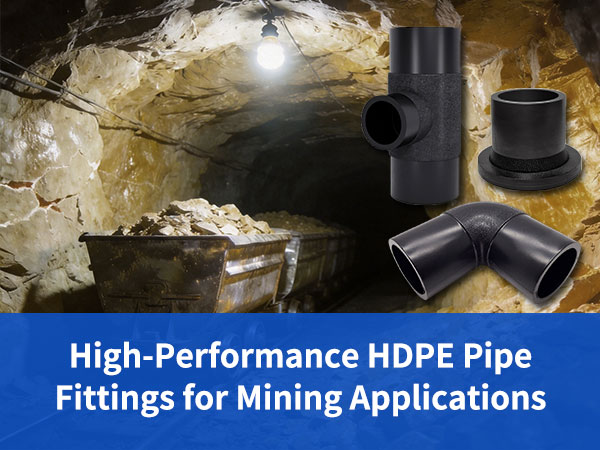
The Rigorous Demands of Mining Environments on Pipe Fittings
Mining transport environments are characterized by a typical “three highs and one complexity”:
High Abrasion: The mineral slurry contains a large volume of solid particles.
High Corrosion: Acidic, alkaline, and various chemical media are widely present.
High Pressure: Long-distance transport results in cumulative pressure buildup.
Complex Conditions: The environment features undulating terrain, fluctuating temperatures, and frequent vibrations.
In such an environment, traditional metal pipe fittings frequently encounter the following issues:
Severe internal wall abrasion and short service life.
Increased risk of leakage due to corrosion.
Failure of joint seals.
Frequent maintenance requirements and high operational costs.
In contrast, high-performance HDPE pipe fittings—leveraging their inherent material and structural advantages—have emerged as a key direction for the upgrading of mining systems.

Premium Raw Materials: The Foundation of High Performance
Junrui manufactures its HDPE fittings using high-grade PE100 or PE100-RC raw materials. These materials feature:
A higher Minimum Required Strength (MRS)
Excellent resistance to Slow Crack Growth (SCG)
Superior Environmental Stress Crack Resistance (ESCR)
The PE100-RC material, in particular, demonstrates exceptional resistance to scratching and point loading, making it ideally suited for the complex construction environments found in mining regions.
Through rigorous raw material selection and batch testing, Junrui ensures that every single fitting is built upon a solid foundation for long-term, stable operation.
Integrated Structural Design: Enhancing Overall Strength and Safety
Unlike traditional spliced or welded metal fittings, high-performance HDPE fittings typically utilize an integrated injection molding or compression molding process, resulting in a more uniform structure free from stress concentration points.
The advantages of this design include:
Higher overall strength and superior impact resistance;
Absence of weld defects, thereby reducing the risk of failure;
Smooth inner walls that minimize fluid resistance.
In high-pressure slurry transport systems, this integrated structure effectively prevents ruptures or leaks that might otherwise arise from localized weak points.
Exceptional Abrasion Resistance: Extending the Service Life of Critical Components
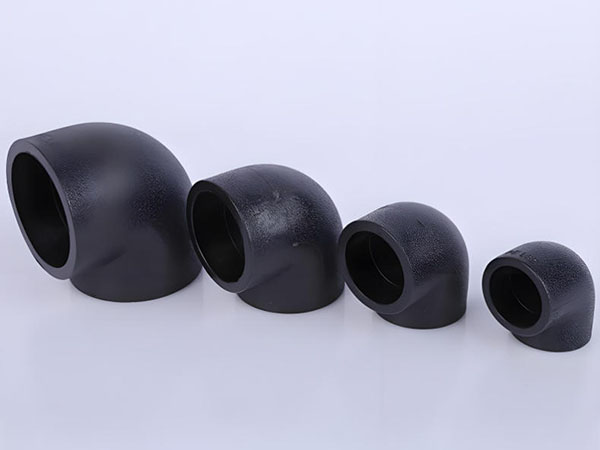
During the transport of mineral slurries, components such as elbows and tees are typically the areas most susceptible to wear.
Junrui HDPE fittings enhance abrasion resistance through the following measures:
Utilization of high-molecular-weight PE materials
Optimization of internal flow channel designs to minimize concentrated erosion
Provision of thickened or abrasion-reinforced structural configurations
Compared to steel fittings, HDPE fittings exhibit a significantly lower wear rate under identical operating conditions, thereby substantially extending the service life of critical components and reducing downtime losses associated with frequent replacements.
Exceptional Corrosion Resistance: Suited for Chemically Complex Environments
Mining systems frequently involve acidic solutions, alkaline media, and saline environments—conditions that impose extremely rigorous demands on piping materials.
HDPE material inherently possesses exceptional chemical inertness:
It does not react with acids or alkalis.
It is immune to electrochemical corrosion.
It requires no additional anti-corrosion treatment.
Consequently, Junrui HDPE fittings demonstrate exceptional stability in the following applications:
Hydrometallurgy systems
Chemical reagent transport
Tailings and wastewater treatment
This characteristic significantly reduces both maintenance costs and safety risks.
Reliable Connection Systems: Achieving True “Zero Leakage”
In mining transport systems, leakage signifies not only a loss of resources but also the potential for severe environmental consequences.
Junrui HDPE fittings support a variety of connection methods:
Butt Fusion
Electrofusion
Flange Connection
Among these, butt fusion and electrofusion connections achieve molecular-level bonding, creating a monolithic structure where the fittings and pipes become a single, integral unit:
Joint strength exceeds that of the base material
Leak-free performance over long-term operation
Capable of withstanding high-pressure conditions
This provides mining clients with an elevated level of safety assurance.

System Compatibility: Ensuring Overall Operational Efficiency
High-performance fittings must not only be “durable” but also exhibit a high degree of compatibility with the entire piping system.
During the design process, Junrui places particular emphasis on:
Consistency between pipe diameter and pressure rating
Fluid dynamics optimization (minimizing turbulence and pressure loss)
Ease of installation and field adaptability
Through a systematic design approach, we ensure that every fitting serves not merely as a connection point, but as a critical node that enhances the overall efficiency of the fluid transport system.
Customization Capabilities: Meeting Complex Mining Requirements
Mining projects often feature highly customized characteristics, such as:
Large-diameter conveying systems
High-pressure rating requirements (PN16 and above)
Non-standard angle fittings or specialized structural components
Junrui possesses comprehensive customization capabilities, enabling us to provide solutions tailored to specific project needs, including:
Non-standard elbows (e.g., 22.5°, 30°, etc.)
Reinforced tees
Large-diameter flange assemblies
Wear-resistant lining structures
We assist clients in achieving optimal system designs for complex operating environments.
Junrui’s Manufacturing Advantages
As a specialized HDPE Pipe Fittings Manufacturer, Junrui offers the following distinct advantages within the mining sector:
High-quality PE100/PE100-RC raw material systems
Advanced injection molding and compression molding processes
Rigorous quality inspections and pressure testing
Extensive experience in mining project applications
We provide not merely products, but a comprehensive suite of services spanning the entire lifecycle—from product selection and design to technical support.
In mining transport systems, pipe fittings—though small in size—bear the critical responsibility of ensuring both system safety and efficiency. With their superior resistance to abrasion and corrosion, high structural strength, and reliable connection capabilities, high-performance HDPE fittings are emerging as a key driver in the modernization of mining piping infrastructure.
Moving forward, Junrui will continue to spearhead technological innovation in HDPE fittings, delivering safer, more efficient, and highly durable solutions to mining clients worldwide.
FAQ
1. What is the primary role of HDPE fittings in mining systems?
HDPE fittings are primarily used for connecting, diverting, and changing the direction of fluid flow—such as elbows, tees, and flanges. In mining transport systems, these fittings directly impact sealing integrity, pressure resistance, and overall operational safety.
2. Why do mining projects require high-performance HDPE fittings?
Mining environments are typically characterized by high abrasion, high corrosion, and high pressure, conditions under which standard fittings are prone to failure. High-performance HDPE fittings are manufactured using premium PE100 or PE100-RC materials, offering superior resistance to abrasion, corrosion, and impact, thereby significantly enhancing system reliability.
3. Are HDPE fittings suitable for transporting mineral slurries?
Yes. HDPE fittings feature smooth inner walls and excellent abrasion resistance, effectively minimizing the erosive impact of mineral particles on the pipe walls. They are particularly well-suited for tailings transport and slurry systems with high solids content.
4. How do HDPE fittings perform in corrosive environments?
HDPE material possesses exceptional chemical stability, allowing it to withstand acids, alkalis, and various chemical media without undergoing electrochemical corrosion. This makes it highly suitable for use in mining chemical environments and wastewater treatment systems.
5. Are the connection methods for HDPE fittings safe and reliable?
HDPE fittings are typically joined using butt fusion or electrofusion techniques. Once connected, they form a monolithic structure where the joint strength exceeds that of the base material, ensuring long-term, leak-free operation. This offers a level of safety far superior to traditional connection methods.
6. What is the service life of HDPE fittings?
Under normal operating conditions, HDPE fittings can have a service life exceeding 50 years. Their inherent resistance to abrasion and corrosion translates into longer maintenance cycles and a lower frequency of replacement within mining systems.
7. Does Junrui offer custom HDPE fittings for mining applications?
Yes. Junrui provides a wide range of standard specifications as well as non-standard custom solutions tailored to specific mining project requirements—including large-diameter fittings, special-angle elbows, and high-pressure-rated products—to meet the demands of complex operating conditions.
8. Can HDPE fittings serve as a substitute for metal fittings? In most mining conveyance applications, HDPE fittings can serve as a substitute for traditional metal fittings, offering distinct advantages—particularly in terms of corrosion resistance, abrasion resistance, and maintenance costs.


