

HDPE butt fusion fittings are key connection components in plastic pipe systems and are widely used in water supply, gas, chemical industry, mining and other fields. It uses hot-melt butt technology to form a high-strength, leak-free permanent connection with excellent corrosion resistance, flexibility and long life. This article will explore the types, processes, advantages, applications and quality control points of HDPE butt fusion fittings in depth.
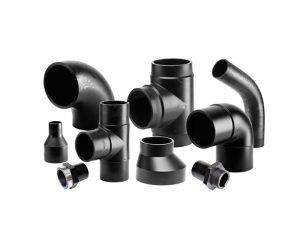
Overview of HDPE butt fusion fittings
1. Basic definition
HDPE butt fusion fittings are pipe fittings connected to HDPE pipes through the Butt Fusion process, including elbows, tees, reducers, flanges, etc. Its material is consistent with the pipe, ensuring that the system has uniform physical and chemical properties after welding.
2. Main types
| Type | Application | Common Sizes |
| Elbow | Change pipe direction (45°, 90°) | DN63–DN800 |
| Tee | Branching or merging flow | DN63–DN800 |
| Reducer | Connect different pipe diameters | DN63–DN800 |
| Flange Adaptor | Connect to metal pipes or equipment | DN50–DN1400 |
| End Cap | Seal the end of a pipeline | DN63–DN800 |
Detailed explanation of HDPE butt welding process
1. Welding principle
HDPE butt welding uses a heating plate to melt the end faces of the pipe and fittings, applies pressure to fuse them, and forms a seamless connection after cooling. The welding temperature is usually controlled at 200-230°C, and the pressure is adjusted according to the pipe diameter.
2. Welding steps
End milling: Ensure that the end faces of the pipe and fittings are flat and clean.
Heating on the heating plate: Heat to a molten state (about 210°C).
Heat absorption stage: The end faces of the pipe and fittings melt on the heating plate.
Butt pressurization: Remove the heating plate, quickly butt and apply pressure.
Cooling and curing: Maintain pressure until cooling to form a high-strength connection.
3. Key parameters
| Parameter | Standard Range |
| Heating Temperature | 200–230°C |
| Heating Time | 20–60 seconds (depending on pipe diameter) |
| Butt Fusion Pressure | 0.15–0.3 MPa |
| Cooling Time | 10–30 minutes |

Advantages of HDPE butt fusion fittings
1. Excellent sealing
No risk of interface leakage, suitable for high-pressure transmission (gas, chemical fluids).
The molecular fusion of the weld surface, the strength ≥ the pipe itself.
2. Corrosion resistance and long life
Acid, alkali, salt spray, ultraviolet (adding carbon black).
Design life of more than 50 years, maintenance-free.
3. Economical and environmentally friendly
No flanges, glue or mechanical connectors are required, reducing installation costs.
100% recyclable, in line with green building standards.
4. Wide application
Water supply and drainage projects: municipal water supply, sewage network.
Gas transmission: medium and low pressure natural gas pipelines.
Industrial pipelines: chemical, mining, power cable protection.
Quality control and common problems
1. Welding quality inspection
Visual inspection: uniform welding flange, no bubbles, impurities.
Pressure test: 1.5 times the working pressure for 30 minutes without leakage.
Ultrasonic detection (optional): check the internal fusion quality.
2. Common Problems and Solutions
| Issue | Cause | Solution |
| Uneven Weld Bead | Uneven pipe ends or pressure | Re-machine ends, adjust clamps |
| Cold or Weak Weld | Insufficient heating or rapid cooling | Increase temperature, extend cooling time |
| Oxidation Layer Interference | Contaminated or oxidized heating plate | Clean heating plate, use nitrogen protection |

Selection and installation suggestions
1. Selection points
Matching pipe grade: PE100 or PE100RC.
Pressure level: PN6-PN25 (according to system requirements).
Certification standards: in accordance with GB/T 13663, ISO 4427, etc.
2. Installation precautions
Ambient temperature: 5-40°C is appropriate, avoid welding in windy and snowy weather.
Storage requirements: avoid direct sunlight to prevent deformation.
Welding machine calibration: regularly check the heating plate temperature and pressure system.
HDPE butt fusion fittings have become the first choice for modern pipeline engineering due to their high strength, corrosion resistance and long life. Correct selection of pipe fitting specifications and strict control of welding process can ensure safe and reliable operation of the system.


