

Which Pipe Fittings Are Required in Water Supply Systems? How Do You Select the Appropriate Specifications?
In water supply systems, pipe fittings serve a purpose far beyond merely connecting pipes; they directly impact the system’s leak-tightness, stability, and service life. Whether for municipal water supply, industrial water usage, or agricultural irrigation, selecting the appropriate Water Supply Pipe Fittings Solutions is critical to the success of any project.
As a specialized supplier of piping accessories, Junrui offers comprehensive solutions for both HDPE and PVC water supply fittings, helping clients quickly determine:
Which specific fittings are required?
Which dimensions should be selected?
Which connection method is most suitable?
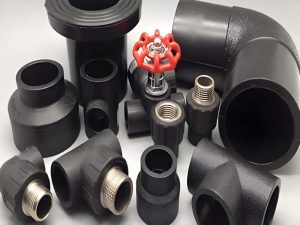
Common Types of Fittings in Water Supply Systems (Which Ones Do You Need?)
Different engineering structures have varying requirements for pipe fittings. The following are the most common configurations:
✔ Elbow
Function: Changes the direction of the pipeline (45° / 90°)
Applications: Routing around corners or obstructions
Recommendation: For main pipelines, prioritize the use of same-diameter elbows to minimize pressure loss.
✔ Tee
Function: Branches the water flow
Applications: Branching off main lines, supplying specific zones
Common Types: Equal Tee / Reducing Tee
✔ Coupling
Function: Connects two pipes of the same diameter
Applications: Extending pipelines or performing repairs
✔ Reducer
Function: Connects pipes of different diameters
Key Point: Avoid sudden diameter reductions to minimize water hammer effects.
✔ Flange
Function: Creates a detachable connection (commonly used at equipment interfaces)
Applications: Pump stations, valve connections
✔ End Cap
Function: Seals off the end of a pipeline

How to Choose the Correct Pipe Fitting Size?
This is one of the most important concerns for customers 👇
1. Fitting Size = Pipe Size
Principle:
The nominal diameter (DN) of the fitting must match the pipe.
Examples:
DN110 pipe → use DN110 fittings
DN200 pipe → use DN200 fittings
2. Select Pipe Diameter Based on Flow Rate (Key Factor)
| Application Scenario | Recommended Diameter |
| Small water supply system | DN20–DN63 |
| Agricultural irrigation | DN63–DN160 |
| Municipal water supply | DN110–DN400 |
| Large-scale water transfer | DN400+ |
Rule:
The larger the flow rate → the larger the pipe diameter
3. Select Pressure Rating (PN Class)
| Pressure Rating | Application |
| PN6 | Low-pressure systems |
| PN8–PN10 | Standard water supply |
| PN12.5–PN16 | High-pressure supply |
Important:
The pressure rating of the fittings must be equal to or higher than the pipe’s pressure rating.

How to Choose Between Different Pipe Fitting Materials? (HDPE vs. PVC)
✔ HDPE Fittings (Recommended)
Suitable for:
Municipal Water Supply
Underground Piping Networks
Long-term Infrastructure Projects
Advantages:
✔ Heat-fusion joining for a completely leak-proof seal
✔ High flexibility; resistant to ground settlement
✔ Long service life
✔ PVC / UPVC Fittings
Suitable for:
Agricultural Irrigation
Low-pressure Water Supply
Cost-sensitive Projects
Advantages:
✔ Low cost
✔ Simple installation
Which to Choose?
| Application Scenario | Recommendation |
| Municipal water supply | HDPE |
| Industrial systems | HDPE |
| Agricultural irrigation | PVC / HDPE |
| Low-pressure systems | PVC |

How to Choose a Connection Method?
✔ HDPE Fittings
Butt Fusion
Electrofusion
Advantages: No risk of leakage
✔ PVC Fittings
Solvent Cement Joining
Rubber Ring Joining
Advantages: Rapid installation
Why Choose Junrui Fittings?
✔ Comprehensive Product Range
HDPE Fittings
PVC / UPVC Fittings
Complete Range of Sizes and Specifications
✔ Precise Specification Matching
We assist our clients by:
Determining the correct DN size
Matching the appropriate pressure rating
Recommending the optimal connection method
✔ Reliable Quality Assurance
Standardized Manufacturing
Rigorous Testing
Suitable for Global Projects
✔ Project Solution Support
We offer more than just products; we provide:
System configuration recommendations
Guidance on fitting selection
Cost optimization solutions
How to Quickly Select the Right Pipe Fittings?
Simply provide the following information, and we will match you with a complete solution:
Pipe Material (HDPE / PVC)
Pipe Diameter (DN)
Pressure Rating (PN)
Application Scenario (Municipal / Industrial / Agricultural)
Junrui will provide a complete list of fittings and a quotation within 24 hours.
Selecting the right water supply fittings essentially boils down to matching three key criteria:
✔ Correct Size (DN)
✔ Correct Pressure (PN)
✔ Correct Material (HDPE or PVC)
Junrui makes selecting pipe fittings simple, professional, and reliable.
FAQ
1. How do I choose the right pipe fitting size for my water supply system?
The fitting size should match the pipe size. For example, a DN110 pipe requires DN110 fittings. Always ensure consistent dimensions across the system to avoid leakage or installation issues.
2. What is the difference between HDPE and PVC pipe fittings?
HDPE fittings are more flexible, durable, and suitable for long-term and underground use. PVC fittings are more cost-effective and easier to install, ideal for low-pressure or irrigation systems.
3. Which pressure rating (PN) should I choose for pipe fittings?
The pressure rating of the fittings must be equal to or higher than the pipe system. For most water supply systems, PN10–PN16 is commonly recommended.
4. What connection methods are used for water supply pipe fittings?
HDPE fittings typically use butt fusion or electrofusion for leak-free connections. PVC fittings use solvent cement or rubber ring connections for quick installation.
5. Can I use different types of fittings in one system?
Yes, but compatibility must be ensured. For example, HDPE and PVC systems may require special transition fittings such as flange adapters.
6. How can Junrui help me select the right fittings?
Junrui provides full solution support. Simply share your pipe size, pressure, and application, and we will recommend the correct fittings and configuration within 24 hours.


