

Definition and function of HDPE pipe elbow
Standard elbow for HDPE pipe is a prefabricated connector used to change the direction of the pipeline. Its bending angle is usually 45°, 90° or 180° and is manufactured by injection molding or hot melt molding. As a key component of the HDPE pipeline system, the elbow can effectively reduce fluid resistance, avoid eddy currents and pressure losses caused by sudden changes in direction, and maintain the sealing and mechanical strength of the pipeline system.
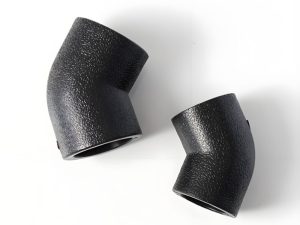
Classification and specifications of standard elbows
1. Classification by bending angle
45° elbow: suitable for gentle flow adjustment, with low pressure loss
90° elbow: the most commonly used model, used for right-angle turning
180° elbow (return elbow): achieves complete reverse flow
2. Classification by connection method
Butt-melt elbow: requires a special welder for end-face welding
Electrofusion elbow: built-in resistance wire, powered heating for connection
Flange elbow: suitable for occasions that require frequent disassembly
3. Standard size specifications
Complies with international standards such as GB/T 13663.2-2018 and ISO 4427, common nominal diameter (DN) range:
Small diameter: DN20-DN110 (for home decoration)
Medium diameter: DN150-DN400 (for municipal engineering)
Large diameter: DN450-DN1200 (for industrial pipelines)
Core performance parameters and technical standards
1. Pressure level:
PN6, PN8, PN10, PN16 (number represents rated working pressure, unit bar)
SDR value (standard dimension ratio) determines pressure bearing capacity, such as SDR11≈PN12.5
2. Material performance:
Raw materials must meet PE80/PE100 grade requirements
Melt index (MFR) ≤0.5g/10min (190℃/5kg)
Long-term hydrostatic strength ≥8.0MPa (20℃/50 years, PE100)
3. International standard comparison:
China: GB/T 13663
International: ISO 4427
USA: ASTM D3035
Europe: EN 12201

Manufacturing process and quality control
Injection molding process:
Use screw injection molding machine, mold temperature controlled at 30-50℃
Cooling time ≥ 60% of molding cycle to avoid internal stress
Key quality inspection items:
Appearance inspection: no bubbles, dents, impurities
Dimension tolerance: bending radius deviation ≤ ± 2%
Pressure test: 1.5 times PN pressure for 3 minutes without leakage
Melt mass flow rate (MFR) test
Key points of engineering application
1. Selection principle
Select the corresponding PN grade according to the working pressure
PE100 raw material elbow must be used for gas pipelines
Cold-resistant modified formula is required for low temperature environment (<-20℃)
2. Installation specifications
Hot melt connection temperature: 200-220℃ (PE100)
Cooling time calculation formula: wall thickness (mm) × 1.5 (minutes)
Minimum bending radius ≥ 25 times the pipe diameter (avoid mechanical stress concentration)
3. Special application solutions
Non-standard angle elbows: Customized molds are used to produce 30°, 60° and other special-shaped elbows
Reinforced elbows: Add rib structure for high vibration conditions
Insulated elbows: Lined with conductive layer for anti-static applications

Solutions to common problems
Problem 1: Leakage at the elbow interface
Countermeasures: Check whether the hot melt temperature meets the standard and ensure that the butt joint pressure is ≥0.15MPa
Problem 2: Brittle cracking during winter installation
Countermeasures: Preheat the pipe to above 5℃ and use low-temperature welding machine parameters
Problem 3: System water hammer effect
Countermeasures: Use large curvature radius elbows (R≥3DN) to buffer impact force
This article systematically sorts out the technical points of Standard elbow for HDPE pipe. In actual projects, it is necessary to combine specific design specifications for selection and application.


