

In various water supply and drainage, agricultural irrigation, electrical wiring, and industrial transmission systems, the connection method of pipelines directly determines the rationality of the system structure and the stability of operation. Among these, the PVC pipe T-joint is an extremely common and crucial type of pipe fitting. Also known as a PVC tee, a PVC pipe T-joint refers to a connector where a branch pipe branches off from a main pipe, forming a “T”-shaped structure. Behind this seemingly simple structure lie numerous technical issues related to fluid mechanics, material properties, structural stress, and engineering matching.
This article will delve into the important role of the PVC pipe T-joint in modern piping systems from the perspectives of structural design principles, manufacturing processes, stress analysis, fluid characteristics, engineering applications, and selection criteria.
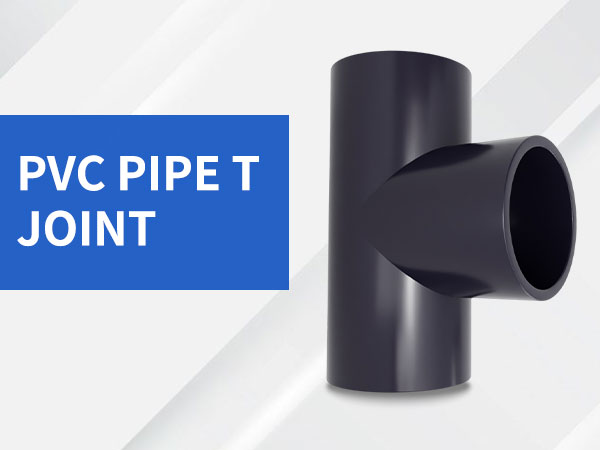
Structural Principles and Types of PVC Pipe T-Joints
The basic structure of a PVC pipe T-joint consists of a main pipe channel and a vertical branch channel, forming a 90° branching structure. Based on their structural form, tees can be divided into:
Equal diameter tees (main and branch pipes have the same diameter)
Reducing tees (branch pipe diameter is smaller than main pipe diameter)
Socket tees
Adhesive tees
Threaded tees. In practical engineering, equal diameter tees are usually used in balanced flow distribution systems, while reducing tees are more often used in branch water supply or graded pressure control systems.
PVC Material Offers Performance Advantages to Tees
PVC (polyvinyl chloride) is a widely used thermoplastic material. Its advantages in tee fittings are mainly reflected in the following aspects:
1. Good Corrosion Resistance
Compared to metal tees which are susceptible to electrochemical corrosion, PVC pipe t joints do not rust and are not corroded by most acidic or alkaline media, making them particularly suitable for underground drainage systems, chemical wastewater systems, and agricultural irrigation systems.
2. Lightweight and Easy Installation
PVC tees are significantly lighter than cast iron or steel tees, making transportation and on-site installation more convenient, reducing labor intensity, and improving construction efficiency.
3. Smooth Inner Wall, Reduced Flow Resistance
The smooth inner wall of PVC material is not prone to scaling, helping to maintain stable flow and reduce system energy consumption.
4. Excellent Insulation Properties
PVC possesses electrical insulation properties, making it suitable for cable protection conduit branch systems, avoiding the risk of electrochemical reactions.
PVC Pipe T-Joint Design from a Fluid Mechanics Perspective
The role of a PVC pipe t-joint in a system is not merely “connection,” but a core node for “flow splitting” and “flow merging.”
When fluid passes through a t-joint, the following changes occur:
Velocity redistribution
Local pressure loss
Increased turbulence
If the t-joint design is inadequate, it may cause:
Sudden drops in local pressure
Pipe vibration
Increased noise
Long-term fatigue damage
Therefore, in high-flow-rate systems, engineers typically:
Optimize branch pipe angles
Control branch pipe diameter ratios
Perform hydraulic calculations
Allow for pressure compensation margins
Reducing tees are particularly important in industrial systems, as they can control flow ratios by changing branch pipe diameters, enabling zoned water supply or discharge.
Stress Analysis and Safety
Tees are among the most stress-intensive nodes in pipeline networks. Their main stress sources include:
Internal fluid pressure
Axial tension in the pipeline
Pressure from underground backfill soil
Thermal expansion and contraction due to temperature changes
In pressure systems, tees generate additional stress concentration. Therefore, high-quality PVC tees should be designed by:
Thickening the branch connection area
Using a reasonable curvature transition
Increasing the pressure rating (e.g., PN10, PN16, etc.)
In underground installations, the tee connection must be backfilled compacted to prevent uneven stress from causing cracking.
Applications of PVC Pipe T-Joints in Various Fields
1. Municipal Water Supply and Drainage Systems
In urban water supply networks, tees are used for branch water supply; in drainage systems, they are used for branch pipes connecting to the main pipe. Equal diameter tees are mostly used in main pressure equalization systems, while reducing tees are mostly used for branch distribution.
2. Agricultural Irrigation Systems
In drip irrigation, sprinkler irrigation, and field irrigation systems, PVC pipe t-joints are used to construct a network distribution structure to achieve uniform irrigation.
3. Industrial Conveying Systems
In chemical and light industrial conveying systems, tees perform the functions of diversion and merging, especially widely used in circulating water systems.
4. Building Drainage Systems
PVC tees are widely used for branch connections of indoor drainage risers due to their ease of installation and low cost.
Comparison of PVC Tees with Tees of Other Materials
| Comparison Item | PVC Tee | Cast Iron Tee | Stainless Steel Tee |
| Corrosion Resistance | Excellent | Prone to Corrosion | Good |
| Weight | Light | Heavy | Relatively Heavy |
| Installation Difficulty | Easy | More Complex | Complex (Welding Required) |
| Cost | Economical | Higher | High |
| Maintenance Cost | Low | Higher | Moderate |
In conventional water supply and drainage systems, PVC tees offer a significant cost-performance advantage. However, metal tees still hold certain advantages in high-temperature, high-pressure, or high-impact environments.
Selection and Installation Considerations:
Define the system pressure rating
Select equal or different diameter tees based on flow rate
Ensure adhesive compatibility
Allow space for thermal expansion and contraction
Conduct pressure testing after construction
Proper installation is crucial for ensuring the long-term stable operation of tees
Future Development Trends:
With the development of plastic modification technology, high-strength PVC materials and composite reinforced structures will further enhance the pressure-bearing capacity and durability of tees.
Standardized production and improved mold precision will also make tee dimensions more accurate, reducing the risk of leakage
Under the trend of green building and low-carbon engineering, lightweight and recyclable PVC tees will maintain their market competitiveness
PVC pipe T-joints (PVC tees), although basic pipe fittings in piping systems, play a critical role in the entire pipe network structure. From fluid distribution to structural pressure bearing, from ease of installation to economic control, their comprehensive value far exceeds their size.
PVC tees will remain an indispensable and important component in future municipal, agricultural, building, and industrial piping systems.
Future Development Trends
With the development of plastic modification technology, high-strength PVC materials and composite reinforced structures will further enhance the pressure-bearing capacity and durability of tees. Simultaneously, standardized production and improved mold precision will result in more accurate tee dimensions, reducing the risk of leakage.
Under the trends of green building and low-carbon engineering, lightweight and recyclable PVC tees will maintain their market competitiveness.
While PVC pipe T-joints are basic fittings in piping systems, they play a crucial role in the entire pipeline network structure. From fluid distribution to structural pressure bearing, from ease of installation to economic control, their comprehensive value far exceeds their size.
In future municipal, agricultural, building, and industrial piping systems, PVC tees will remain an indispensable and important component.


