

Definition and standard background of PE3408 HDPE pipe fittings
PE3408 is a high-density polyethylene (HDPE) pipe classification code based on ASTM D3350 standard, mainly used in industrial and municipal pressure pipeline systems, such as water supply and gas transmission. Its naming rules are as follows:
“PE”: Polyethylene
“3”: Resin density grade (3 represents medium density)
“4”: SCG resistance performance grade
“08”: Hydrostatic design stress (HDS) at 73°F (23°C) is 800 psi (5.5 MPa).
Compared with new materials such as PE4710 (HDS 1000 psi), PE3408 is still widely used in traditional pressure pipeline systems, especially in the North American market.
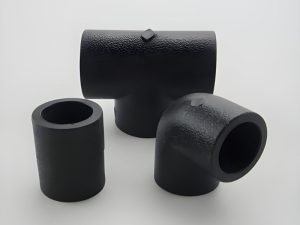
Core performance of PE3408 pipe fittings
1. Mechanical properties
Crack resistance: SCG grade is 4, suitable for medium stress environment, but lower than PE3608 (SCG=6) and PE4710 (SCG=7).
Ring stiffness: Typical value SN8-SN12, suitable for municipal pipe networks with a burial depth of 3-6 meters.
Impact resistance: Izod impact strength ≥20 kJ/m², better than PVC pipes.
2. Chemical stability
Resistant to acid and alkali media with pH 1-14, suitable for chemical wastewater discharge.
Resistant to chloride ion corrosion, can be used for water transport in coastal areas or saline-alkali land.
3. Long-term durability
Design life is 50 years, which can be extended to 70 years in an environment without direct UV exposure.
At 73°F (23°C), the long-term hydrostatic strength (LTHS) meets ISO 9080 standards.
Typical applications of PE3408 pipe fittings
| Application Field | Applicable Scenarios | Supporting Standards |
| Municipal Water Supply | Main water supply pipelines, secondary water supply systems | ASTM F714, GB/T 13663 |
| Gas Transmission | Medium and low-pressure gas networks (requires yellow marking) | ASTM D2513, GB 15558 |
| Industrial Fluid Transport | Chemical media, cooling water circulation systems | ISO 4427, KS M 3408 |
| Agricultural Irrigation | Main pipes for drip irrigation systems (requires UV protection) | GB/T 50485-2020 |

Comparison of PE3408 with other HDPE materials
| Parameter | PE3408 | PE3608 | PE4710 |
| Resin Density | Medium (3) | Medium (3) | High (4) |
| SCG Resistance | 4 | 6 | 7 |
| HDS (psi) | 800 | 800 | 1000 |
| Applicable Pressure | PN10–PN16 | PN12–PN20 | PN20–PN25 |
Note: Although PE3608 has higher crack resistance, HDS is the same as PE3408, and PE4710 has more advantages in high-pressure applications.
Construction and quality control of PE3408 pipe fittings
1. Hot-melt connection process
Temperature control: 210±5°C (PE100 grade material)
Welding pressure: 0.15-0.3 MPa (adjusted according to pipe diameter)
Cooling time: ≥ pipe diameter (mm) × 1 second
2. Installation precautions
Burial depth requirements:
Ordinary soil: ≥1.2 meters
Frozen soil area: ≥freezing line + 0.3 meters
Foundation treatment: Sand cushion thickness ≥15 cm, compaction ≥90%.
3. Quality inspection
Hydraulic test: 1.5 times the working pressure for 1 hour, no leakage.
Ultrasonic flaw detection: Detect the integrity of hot-melt joints.

Industry trends and future prospects
Material upgrade: PE100RC and other high crack-resistant resins gradually replace traditional PE3408 to improve the impact resistance of pipelines.
Intelligent monitoring: integrated fiber optic sensors to detect pipeline leakage and deformation in real time.
Environmental development: bio-based HDPE (such as sugarcane ethanol extraction) reduces carbon footprint.
As a classic HDPE pipe, PE3408 still plays an important role in municipal and industrial fields. Although new materials such as PE4710 are gradually promoted, PE3408 is still a reliable choice for medium and low pressure pipeline systems with its mature process and cost advantages. In the future, through material modification, intelligent monitoring and green manufacturing, PE3408 pipe fittings will further improve performance and adapt to more stringent engineering requirements.


