

In modern plastic piping systems, HDPE (high-density polyethylene) is widely used in water supply and drainage, industrial transportation, mining, agricultural irrigation, and chemical industries due to its excellent corrosion resistance, impact resistance, and long service life. In these systems, besides the pipe material itself, the connection method also determines the system’s safety and stability. HDPE threaded pipe fittings have become an important connection component due to the increasing demand for detachable connections.
This article will comprehensively analyze the structural characteristics, performance advantages, typical applications, and selection points of HDPE threaded pipe fittings.
What are HDPE threaded pipe fittings?
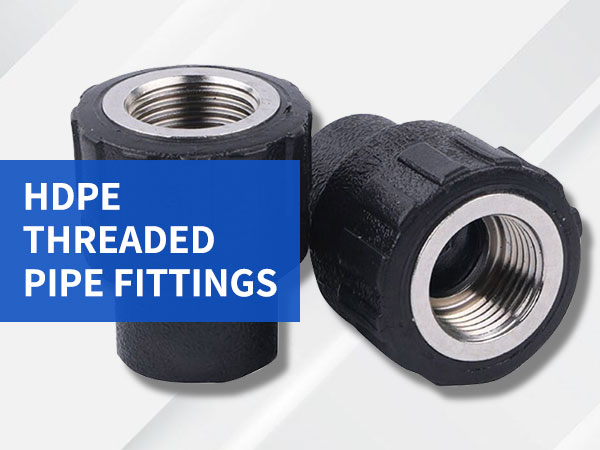
HDPE threaded pipe fittings are pipe connections made primarily of high-density polyethylene (HDPE) through injection molding or machining processes, and featuring internal or external threads at the ends. They are typically used to connect to metal pipes, valves, instruments, or other threaded equipment.
Common types include:
Male Threaded Adapter
Female Threaded Adapter
Threaded Elbow
Threaded Tee
Threaded Coupling
HDPE + Brass/Steel Insert
Unlike butt fusion and electrofusion connections, threaded connections are mechanical connections, characterized by their detachability and ease of maintenance.
Structural Features of HDPE Threaded Pipe Fittings:
1. Plastic Body + Metal Insert Structure: To enhance thread strength, many HDPE threaded pipe fittings incorporate brass or stainless steel rings at the threaded portion, forming a composite structure of “plastic body + metal thread.” This design retains the corrosion resistance of HDPE while improving the mechanical strength and wear resistance of the threaded connection.
2. Standardized Thread Specifications: HDPE threaded pipe fittings typically conform to internationally recognized thread standards, such as:
BSP (British Standard Pipe Thread)
NPT (American Standard Tapered Pipe Thread). Standardized design ensures reliable connection to various valves, pumps, instruments, and metal pipe fittings.
3. One-Piece Injection Molding: Most HDPE threaded pipe fittings are manufactured using high-pressure injection molding, resulting in a one-piece molding process without welds or stress concentration points, leading to a more stable structure.
Key Advantages of HDPE Threaded Pipe Fittings:
1. Excellent Corrosion Resistance: HDPE itself has strong resistance to acids, alkalis, salts, and most chemical media. Unlike metal pipe fittings, it will not rust or undergo electrochemical corrosion, making it ideal for chemical, mining, and water treatment environments.
2. Good Impact Resistance: HDPE material has high toughness and is not easily brittle even at low temperatures, making threaded pipe fittings safer and more reliable during transportation, installation, and operation.
3. Lightweight and Easy to Install: Compared to metal threaded joints, HDPE threaded pipe fittings are lighter and easier to install, effectively reducing construction intensity and improving installation efficiency.
4. Removable and Convenient Maintenance: The biggest advantage of threaded connections is their removability. When the system needs maintenance, valve replacement, or instrumentation, there is no need to cut the pipe, greatly facilitating later maintenance.
5. Strong Compatibility with HDPE Piping Systems: HDPE threaded joints typically have a heat-fused socket or butt joint on one end and a threaded interface on the other, enabling a reliable transition connection between HDPE pipes and metal equipment.
Application Areas
1. Agricultural Irrigation Systems
In drip and sprinkler irrigation systems, HDPE main pipes are often connected to metal valves, water meters, and filters, making threaded fittings a crucial transition component.
2. Water Supply and Drainage and Water Treatment Engineering
HDPE threaded fittings are commonly used at the interfaces of equipment such as pumps, flow meters, and pressure gauges, ensuring both sealing and ease of equipment disassembly and maintenance.
3. Industrial and Chemical Transportation Systems
When transporting corrosive liquids or chemicals, HDPE threaded fittings can replace some metal joints, reducing corrosion risks and extending system lifespan.
4. Mining and Tailings Treatment
HDPE threaded fittings are widely used in mining area water supply and chemical dosing systems, as well as some low-pressure transmission pipelines, due to their corrosion resistance and impact resistance.
Installation and Sealing Precautions
Although HDPE threaded pipe fittings are easy to install, the following points should still be noted:
1. Use suitable sealing materials
PTFE tape or dedicated thread sealant is recommended to ensure a reliable seal at the joint.
2. Avoid overtightening
While HDPE itself has high strength, excessive force may cause thread deformation or cracking. Install according to the recommended torque.
3. Avoid prolonged use in high-temperature environments
HDPE has limited temperature resistance, and threaded connections are not suitable for high-temperature, high-pressure systems. Use within the design limits.
4. Use support and fixation
Threaded connections should not be subjected to excessive tensile or bending moments. Proper pipe support should be provided to reduce stress on the joint.
Comparison of HDPE threaded pipe fittings with other connection methods
| Connection Method | Detachable | Sealing Reliability | Installation Difficulty | Typical Applications |
| Butt Fusion Connection | No | Very High | Medium | Permanent main pipeline systems |
| Electrofusion Connection | No | Very High | High | High-requirement pressure systems |
| Flange Connection | Yes | High | High | Large diameter pipes, equipment connections |
| Threaded Connection | Yes | Medium to High | Low | Small diameter pipes, equipment interfaces |
It can be seen that HDPE threaded pipe fittings are more suitable for small-diameter, low-to-medium pressure applications, locations requiring frequent maintenance, or equipment connections.
As an important supplementary connection method in HDPE piping systems, HDPE threaded pipe fittings play an irreplaceable role in equipment interfaces, transition connections, and detachable parts. They combine the corrosion resistance and flexibility of HDPE material with the convenience and maintainability of threaded connections, making them widely used in agricultural irrigation, water treatment, and industrial transportation.
With proper selection of specifications, correct installation, and use within the applicable pressure and temperature range, HDPE threaded pipe fittings can provide a safe, economical, and efficient connection solution for piping systems.


