

In modern plastic piping engineering, HDPE (high-density polyethylene) piping systems are widely used in water supply and drainage, industrial transportation, mining, chemical, and municipal engineering fields due to their excellent corrosion resistance, flexibility, and long service life. However, in scenarios involving large diameters or special angle connections, traditional injection-molded pipe fittings often fall short of requirements. In these cases, HDPE segmented fittings become a key solution.
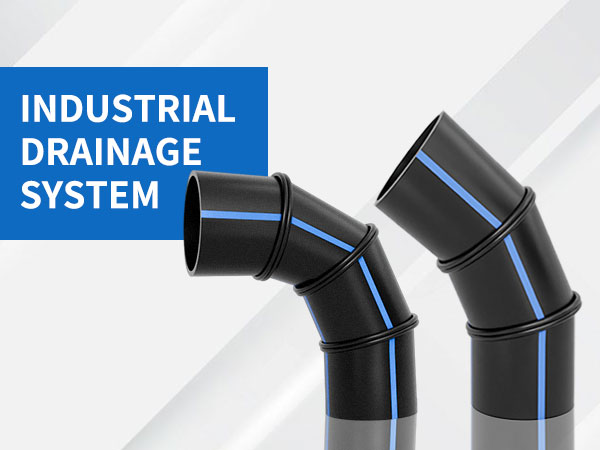
What are HDPE Segmented Fittings?
HDPE segmented fittings, also known as spliced fittings or segmented welded fittings, are pipe fittings made by cutting HDPE pipes at specific angles and then joining them together through hot-melt welding. Common types include:
Elbows
Tees
Crosses
Reducers
Laterals
Unlike one-piece injection-molded fittings, segmented fittings are engineering-grade fittings “remanufactured from pipe material,” making them particularly suitable for large-diameter, non-standard angle, or special structural piping systems.
Why are segmented pipe fittings needed?
In small-diameter piping systems, injection-molded pipe fittings are readily available and inexpensive. However, when pipe diameters increase (e.g., above DN315, especially large diameters like DN630, DN800, and DN1000):
Injection mold costs are extremely high.
Transportation and inventory are difficult.
Special angles (e.g., 22.5°, 30°, 60°) are difficult to standardize for production.
Therefore, in engineering, segmented pipe fittings are often manufactured using a cutting + hot-melt welding process, which is both flexible and economical.

HDPE Segmented Pipe Fitting Manufacturing Process
The core of HDPE segmented fittings lies in high-precision cutting and hot-melt welding technology.
1. Pipe Angle Cutting
Based on the design angle (e.g., a 45° elbow is usually spliced from multiple 22.5° segments), HDPE straight pipes are cut into segments with the required angles. Cutting accuracy directly affects the subsequent welding quality and fluid flow.
2. Hot-melt Butt Welding
The cut pipe segments are heated to a molten state using a butt welding machine and then butt-welded together. After cooling, they form a single integral structure. The strength of the weld joint is generally not lower than that of the pipe body.
3. Quality Inspection
Including: Visual inspection of welds
Inspection of weld symmetry
Non-destructive testing (if necessary)
Hydrostatic or pneumatic pressure testing
High-quality split pipe fittings should have uniform, full welds, free of porosity and slag inclusions.
Key Advantages of HDPE Split Pipe Fittings:
Suitable for Large Diameter Pipes
Split pipe fittings can be manufactured to very large sizes as needed, making them an indispensable component of large-diameter HDPE systems.
Flexible and Customizable Angles
Elbows or irregular tees of any angle can be manufactured according to project requirements, accommodating complex pipeline routes.
Same Strength as the Main Pipe
A monolithic structure of the same material is formed through hot-melt welding, avoiding the leakage risks of traditional mechanical connections.
Corrosion and Wear Resistance
Inheriting the inherent properties of HDPE material, it is suitable for transporting complex fluids such as those containing silt, slurry, and chemical media.
Lightweight and Easy to Install
Compared to metal pipe fittings, HDPE split pipe fittings are lighter, making transportation and installation easier.

Differences from Injection Molded Pipe Fittings
| Comparison Item | Segmented Fittings | Injection Molded Fittings |
| Manufacturing Method | Fabricated by cutting and butt fusion welding of pipe sections | One-piece injection molding using molds |
| Suitable Diameter Range | Especially suitable for large diameters | Mainly used for small to medium diameters |
| Angle Options | Custom angles available | Mostly standard angles |
| Cost Structure | More economical for large diameters | More economical for small diameters |
| Lead Time | Custom-made based on size | Standard items usually available from stock |
Typical Applications of HDPE Split Pipe Fittings:
Industrial Drainage Systems: Used to connect large-diameter underground sewage trunk lines, ensuring a leak-free and corrosion-resistant system.
Mining Conveying Systems: Suitable for conveying slurries, tailings, and highly abrasive media, offering excellent wear resistance.
Municipal Water Supply and Drainage Engineering: Split elbows and tees are commonly used in large-diameter water supply and drainage networks.
Chemical and Wastewater Treatment: Resistant to corrosion from various chemical media, widely used for industrial wastewater transportation.
Rainwater and Flood Control Drainage Systems: In high-flow drainage projects, large-diameter split pipe fittings effectively adapt to the needs of complex terrain layouts.

Installation Precautions
While segmented fittings offer superior performance, installation quality is equally crucial:
Must be operated by professional welders.
Welding equipment must be calibrated and certified.
Clean the welding surfaces before installation.
Strictly control heating time and connection pressure.
Conduct a pressure test after installation.
Proper installation is essential to ensure the long-term stable operation of the piping system.
HDPE segmented fittings are an indispensable component of modern HDPE piping systems, demonstrating irreplaceable advantages, especially in large-diameter and complex engineering conditions. Through high-quality manufacturing and standardized installation, segmented fittings provide the same strength and sealing performance as the main pipe, offering safe, reliable, and durable piping connection solutions for industrial, municipal, and mining sectors.


