

In modern fluid transportation systems, high-density polyethylene (HDPE) pipes are highly sought after for their superior corrosion resistance, flexibility, and long life. However, a complete piping system requires not only high-quality pipes but also safe and reliable fittings. HDPE threaded fittings, as a specialized and critical connection element, play an indispensable role as a bridge when interfacing with existing equipment or other pipe materials. This article will delve into the world of HDPE threaded fittings, analyzing their characteristics, applications, and proper use.
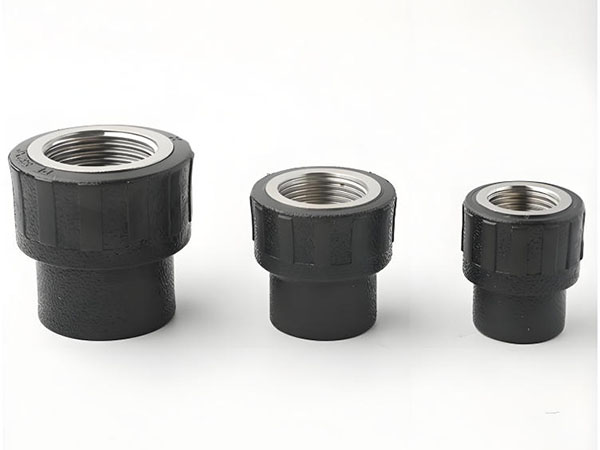
What are HDPE threaded fittings?
HDPE threaded fittings are pipe connectors made of high-density polyethylene (HDPE) through an injection molding process and feature standard threads (usually NPT or BSPT). Their primary function is to reliably connect HDPE piping systems to threaded equipment, valves, or other pipe materials (such as steel, brass, or PVC).
Unlike the mainstream heat-fusion (butt-welding or electric fusion) methods used for HDPE pipe, threaded fittings are removable mechanical connections. This provides significant flexibility in system installation, maintenance, modification, and expansion.
Common Types of HDPE Threaded Fittings
HDPE Female/Male Connectors: The most basic adapters, with a heat-melt socket on one end (for heat-melting HDPE pipe) and either internal or external threads on the other.
HDPE Threaded Flange: One end is heat-melted to the HDPE pipe, and the other end features an HDPE flange with bolt holes. This flange can be bolted to a steel flange, making it a classic solution for connecting HDPE pipe to steel piping systems.
90° and 45° HDPE Threaded Elbows: Threaded elbows used to change the direction of a pipe and simultaneously convert connections.
HDPE Tee/Cross Threaded Fittings: Used for dividing or combining flows, with one or more outlets having a threaded connection.
HDPE Threaded Plugs/Caps: Used to seal the end threaded connection of a pipe.
HDPE Threaded Union: A special fitting that allows for disconnection without rotating the pipe, making it very convenient for maintenance.

Advantages
1. Excellent Compatibility and Flexibility: This is its core advantage. It allows all-plastic HDPE piping systems to easily connect to nearly any device with standard threaded connections, such as pumps, filters, valves, water meters, and tanks, breaking down barriers between piping systems made of different materials.
2. Removability and Maintainability: Threaded connections allow for inspection, replacement, or cleaning of specific components in the system without disrupting the entire piping system. This significantly reduces the cost and complexity of future maintenance.
3. Easy Installation, No Extensive Equipment Required: Unlike hot-melt connections, which require specialized welding equipment, threaded connections typically require only appropriate tools (such as pipe wrenches and strap wrenches) and sealing materials (tissue tape or sealant). This is particularly convenient and quick in applications where space is limited or where large equipment is inconvenient.
4. Inheriting the Excellent Properties of HDPE: The pipe fittings possess the inherent advantages of HDPE, such as corrosion resistance (no rust and seizure like metal threads), light weight, excellent toughness, and a smooth interior, ensuring efficient and pure fluid transportation.
Main Application Areas
Industrial Process Systems: Connect reactors, storage tanks, metering pumps, and filters in chemical plants, electroplating plants, and laboratories.
Water Treatment Engineering: Connect filters, softeners, reverse osmosis (RO) membrane housings, UV sterilizers, and dosing pumps.
Irrigation Systems: Connect pump stations, control valves, fertilizer tanks, and sprinklers.
Building Water Supply and Drainage: Serves as a transitional connection between HDPE main pipes and indoor metal branch pipes, water heaters, and water tanks.
Mining and Marine Engineering: Provides a reliable solution for applications requiring frequent equipment disassembly and connection.

Precautions and Limitations
Pressure Rating Limitations:
Threaded connections are the lowest-pressure-carrying component of the entire HDPE piping system. Because thread turning inevitably reduces pipe wall thickness and creates stress concentrations at the root, their rated working pressure (PN) is significantly lower than that of heat-melted pipe. Any form of heat-melt welding on threaded fittings is strictly prohibited, as this will deform and render them useless.
Proper Sealing Methods:
Use specialized plastic thread sealing tape (tap tape) or a liquid sealant suitable for plastic. Never use sealing pastes or oil-based compounds, as they may contain solvents that can stress-crack HDPE.
When wrapping the taping, wrap it in a clockwise direction (in the direction of thread tightening) to prevent it from being drawn into the pipe and causing contamination.
Avoid Overtightening (Critical!):
HDPE is much softer than metal. Overtightening can generate significant hoop stresses that far exceed the material’s yield strength, potentially causing pipe rupture or future stress cracking. The principle of tightening is “hand-tighten, then tighten with a tool 1/2 to 3/4 turn” until a leak-proof seal is achieved. Using a torque wrench is strongly recommended, and the manufacturer’s specified torque values must be adhered to.
Avoid cross-threading:
During installation, first tighten by hand several turns to ensure proper thread alignment before tightening with a tool. Forcing cross-threads can permanently damage the fitting.
Temperature Considerations:
HDPE has a greater coefficient of linear expansion than metal. Under hot and cold cycling conditions, the different expansion and contraction rates of the two materials can cause threaded connections to leak, necessitating regular inspection.
HDPE threaded fittings are the most flexible and versatile “adapters” in HDPE piping systems. Despite their small size, they shoulder the important task of connecting different worlds and ensuring system integrity. Only by correctly understanding and applying them and adhering to a “gentle, precise, and restrained” installation philosophy can we maximize their advantages, mitigate potential risks, and build a modern fluid transport system that is both durable and flexible.


