

As the core component of modern engineering pipeline system, HDPE sdr 11 fittings have excellent performance due to the unique molecular structure design. Made of PE100 grade high-density polyethylene raw material and produced through advanced catalytic polymerization process, they have highly linear molecular chains and appropriate branching degree, and the crystallinity can reach more than 70%. This microstructure gives the material the following properties:
Mechanical properties
Tensile strength ≥ 22MPa (GB/T 1040)
Flexural modulus 900-1100MPa
Notched impact strength > 20kJ/m² (-20℃)
Physical properties
Density 0.948-0.965g/cm³ (ASTM D792)
Vicat softening point 125℃ (GB/T 8802)
Linear expansion coefficient 1.8×10⁻⁴/℃
Chemical stability
Acid and alkali resistance range pH1-14 (short-term contact)
Organic solvent resistance (excellent for alcohols and oils)
Environmental stress cracking resistance F₅₀> 1000h (GB/T 1842)
The international standard system has strict regulations for SDR11 pipe fittings:
ISO 4427: Specified dimensional tolerance ±0.3mm
ASTM F714: Required hydrostatic strength 4.6MPa (20℃, 100h)
EN 12201: Oxidation induction time > 20min (200℃)
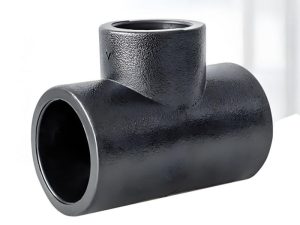
Comparative analysis of engineering performance
Comparison of hydraulic characteristics
Calculated by the Darcy-Weisbach formula, when the flow rate of DN200 pipe is 2m/s:
HDPE SDR11: hydraulic slope 0.0045
Cast iron pipe: hydraulic slope 0.0072
Concrete pipe: hydraulic slope 0.0098
This means that at the same flow rate, the HDPE system can reduce pumping energy consumption by 37%, and can save about 150,000 kWh/km of electricity in a ten-year operation cycle.
Mechanical performance comparison test data
The long-term tracking of buried pipelines by a third-party testing agency shows:
| Performance Indicator | HDPE SDR11 | Ductile Iron | PVC-U |
| 50-Year Creep Deformation Rate | 1.2% | 0.8% | 3.5% |
| Deflection under Soil Load | 4.8% | 2.1% | 6.9% |
| Seismic Displacement Adaptability | 7.2% | 3.5% | Fracture |
Life cycle cost analysis
Take DN300 water supply pipeline as an example (20km length, design pressure 1.0MPa):
| Cost Item | HDPE SDR11 | Steel Pipe with Anti-corrosion Treatment |
| Material Cost | 3.8 million CNY | 4.2 million CNY |
| Installation Cost | 1.5 million CNY | 2.8 million CNY |
| 50-Year Maintenance Cost | 0.2 million CNY | 1.8 million CNY |
| Residual Value Rate | 30% | 10% |
A total cost present value comparison shows that the HDPE option saves approximately 32% and reduces carbon emissions by 45%.

HDPE sdr 11 fittings Professional installation technical specifications
Full process of hot melt welding process
Pretreatment stage
Pipe end milling: Use automatic milling cutter to ensure end surface flatness ≤0.1mm
Cleanliness treatment: Use special ethanol wipe to remove grease (residue <0.1mg/cm²)
Alignment calibration: Hydraulic clamp coaxiality deviation <1% wall thickness
Welding parameter control
Temperature control: Infrared temperature measurement of heating plate surface 210±5℃
Pressure stage:
Absorption pressure 0.15MPa (time = wall thickness × 12s)
Switching pressure 0.02MPa (time <4s)
Cooling pressure 0.10MPa (time = wall thickness × 2min)
Quality inspection
Flanging height detection: should be 10% of wall thickness- 20%
Backbend test: no cracking at a bending angle of 30°
Ultrasonic testing: fusion surface defects <5% wall thickness
Key technologies for electric fusion connection
Resistance wire specifications: nickel-chromium alloy wire diameter 0.8mm, resistance value 0.8-1.2Ω/m
Welding energy control:
Calculation formula: Q=1.2×π×D×L (kJ)
Typical parameters: DN200 pipe fittings require 36kJ energy input
Cooling curve management:
Natural cooling rate <5℃/min
Forming time >60 minutes (DN>300)
Mechanical connection system design
Flange connection:
Bolt preload calculation: F=0.7×σₛ×Aₛ
Sealing gasket selection: EPDM rubber hardness 70±5 Shore A
Installation torque table:
| Bolt Specification | Torque Value (N·m) | Tightening Sequence |
| M16 | 60–80 | Diagonal Cross Pattern |
| M20 | 100–120 | Star Pattern |
Clamp connection:
Radial compression is controlled at 3%-5%
Angle of stop teeth is 45±2°
After installation, 3 pressure pulse tests (0.5-1.5PN) are required

Analysis of typical engineering cases
Case 1: Application in Binhai Industrial Park
DN400 acid delivery system in a chemical park:
Medium: 20% sulfuric acid solution, temperature 60℃
Design pressure: 1.0MPa
Special requirements:
Inner lining 2mm anti-corrosion layer
Outer wall adds 3% carbon black anti-UV
Expansion joints are set every 50m
Detection after 3 years of operation:
Wall thickness reduction <0.05mm
Non-destructive testing pass rate of joints 100%
Maintenance cost is 70% lower than the original PP system
Case 2: Gas pipeline in high-cold areas
SDR11 gas pipeline network in Northeast China:
Design temperature: -40℃ to 40℃
Special process:
Use low-temperature impact-resistant modified formula
Preheat welding to above 15℃
Buried depth 1.8m (above frozen soil layer)
Winter emergency detection:
Material impact strength retention rate >85%
Joint air tightness test leakage rate <0.001%
Anti-frost heave deformation ability is better than steel pipe system

Solutions to common problems
Problem 1: Interface leakage
Root cause analysis:
Welding parameter deviation (accounting for 62%)
Material contamination (accounting for 28%)
Improper cooling (accounting for 10%)
Four-level treatment plan:
Primary treatment: External coating reinforcement sleeve (pressure bearing ≤ 0.8PN)
Intermediate treatment: Electric fusion repair (need to cut off the affected area)
Advanced treatment: Pipe section replacement (when the leakage point is greater than 3)
System transformation: Install a pressure balance device (when caused by water hammer)
Problem 2: UV aging
Protection system design:
Basic protection: 2.5% carbon black addition (in accordance with GB/T 18742)
Enhanced protection:
Coating polyurethane topcoat (dry film thickness ≥ 300μm)
Installation of awnings (areas with sunshine intensity greater than 600W/m²)
Detection method:
Infrared spectroscopy analysis of oxidation index
Tensile strength retention rate test
Problem 3: Frost heave damage
Preventive design measures:
Deep burial formula:
h=h₀+0.3+0.1D (h₀ is the freezing depth)
Insulation layer design:
Polyurethane foam thickness ≥ 50mm
Thermal conductivity ≤ 0.025W/(m·K)
Compensation measures:
Set up Z-type compensator (every 30m)
Adopt elastic laying (curvature radius > 25D)


