

HDPE (high-density polyethylene) pipe couplings are key connectors in HDPE piping systems. Their performance directly impacts the sealing, durability, and safety of the entire pipeline network. This article systematically introduces the types, selection methods, installation techniques, and solutions to common problems of HDPE pipe couplings, providing a professional reference for engineering design and construction.
Core Features and Advantages of HDPE Pipe Couplings
1. Material Properties
Corrosion Resistance: Resists acid, alkali, salt, and electrochemical corrosion (pH range 1-14)
Flexibility: Elongation at break >350%, adaptable to foundation settlement (±5° deflection angle)
Low-Temperature Performance: Maintains elasticity at -40°C, eliminating the risk of brittle cracking
Sanitary and Safety: Complies with GB/T 17219 drinking water hygiene standards
2. Mechanical Performance Parameters
| Performance Indicator | Typical Value |
| Tensile Strength | ≥22 MPa |
| Heat Deflection Temperature (under 0.46 MPa) | ≥80℃ |
| Burst Pressure (SDR11) | ≥3.2 MPa |
| Service Life | Over 50 years |
HDPE pipe coupling types and applications
1. Classification by connection method
(1) Electrofusion Coupling
Structural features: built-in resistance wire, electric heating to achieve welding
Applicable pipe diameter: DN20-DN1200
Advantages:
Fully automatic welding, qualified rate > 99%
Non-excavation pipe repair
Typical applications:
Gas pipeline repair
High pressure water supply system (PN1.6MPa)
(2) Butt Fusion Coupling
Process parameters:
Heating plate temperature: 200-220℃
Welding pressure: 0.15-0.3MPa
Quality control points:
Flange height should be 1.1 times the wall thickness
Cooling time ≥ pipe diameter (mm) × 1.2 (s)
(3) Mechanical coupling (Mechanical Coupling
Main Types:
Clamp (applicable to DN50-DN300)
Flange Conversion (pressure rating PN1.0-PN2.5)
Seal:
EPDM rubber ring (temperature resistant -40°C to +120°C)
Stainless steel teeth with anti-slip design
2.Classification by Function
| Type | Feature Description | Applicable Scenario |
| Equal Coupling | Same-diameter connection | Extension section of straight pipeline |
| Reducer Coupling | Tapered transition structure (reduction ratio ≤ 2) | Pump room inlet/outlet |
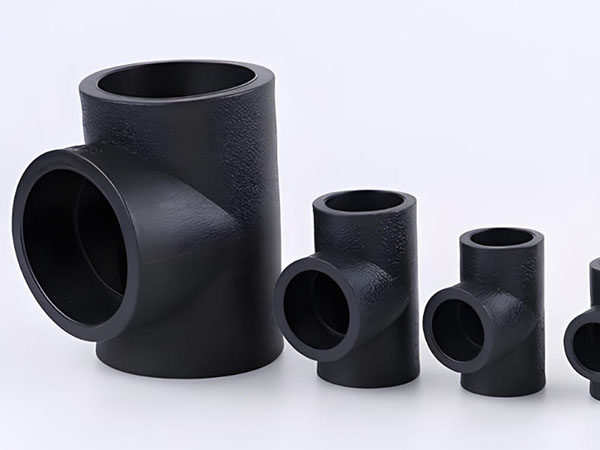
| Tee/Cross Fitting | 45°/90° branch | Pipeline network diversion nodes |
| Flange Adapter Fitting | With HDPE flange base | Connection with valves/metal pipes |

Key Technical Points for HDPE Pipe Coupling Selection
1. Five Selection Factors
Pipe Material Matching:
SDR value deviation should be less than 5%
Material Melt Index (MI) difference should be less than 0.5g/10min
Pressure Rating:
Working Pressure ≤ 0.8 × Rated Pressure
Transient Pressure (e.g., water hammer) ≤ 1.5 × Rated Pressure
Environmental Factors:
Ultraviolet intensity > 120W/m²: Select a coupling with a carbon black content ≥ 2%
For highly corrosive soils, select an all-plastic structure
Construction Conditions:
Electrofusion couplings are preferred for confined spaces
Mechanical quick-connect couplings are recommended for field operations
Economics:
Lifecycle Cost Calculation (including maintenance costs)
2. Common Selection Mistakes
❌ Ignoring the pipe material’s thermal expansion coefficient (α = 0.2mm/m·°C)
❌ Using ordinary rubber seals in chlorine-containing environments
❌ Using non-reinforced couplings for pipes DN > 400mm
Installation Process Standards
1. Electric Fusion Joint Installation Process
Surface Treatment:
Oxide layer scraped to a depth of 0.1-0.2mm
Use a special scraper to ensure axial striations
Pair Positioning:
Gap ≤ 0.5mm (DN ≤ 200)
Use a centering fixture to maintain concentricity
Fusing Parameters:
# Typical Electric Fusion Parameter Calculation (DN 110 as an example)
voltage = 39.5 ± 0.5V
heating_time = pipe diameter (mm)/2 + 30 seconds (in this example = 85 seconds)
cooling_time = heating_time × 2
Quality Inspection:
Observation hole protrusion height ≥ 2mm
No black lines or bubbles in the fusion zone
2. Key Control Points for Butt Fusion
Heating Plate Temperature: Real-time monitoring with an infrared thermometer (±3°C)
Absorption Pressure: Controlled in three stages (0.02MPa → 0.15MPa → 0.3MPa)
Switching Time: <5 seconds (large diameters require hydraulic assistance)
3. Mechanical Joint Installation Precautions
Apply silicone grease to the rubber rings.
Tighten the bolts diagonally (see the table below for torque values).
| Bolt Size | Recommended Torque (N·m) |
| M12 | 45 ± 5 |
| M16 | 80 ± 10 |
| M20 | 160 ± 15 |

Common Problems and Solutions
1. Leak Diagnosis
| Leakage Type | Possible Cause | Solution |
| Joint Leakage | Insufficient fusion temperature | Re-fuse (increase temperature by 10 ℃) |
| Circumferential Leakage | Twisted rubber ring | Replace sealing ring and realign |
| Pressure Burst | Incorrect pressure rating selection | Use PN1.6 MPa grade fitting |
2. Special Working Conditions
Foundation Settlement: Use flexible joints (allowable displacement ≥ 5% of the pipe diameter)
Low-Temperature Environments: Preheat the pipe to above 5°C before installation
Chemical Media: Use PTFE-lined joints
HDPE pipe joints are core components of modern pipeline engineering. Their correct selection and proper installation directly impact system reliability. Recommendations:
Use electric fusion joints and butt fusion joints for dual protection at critical nodes.
Establish a joint installation parameter database for quality traceability.
Perform regular airtightness testing (recommended every two years).


