

High-density polyethylene (HDPE) pipe fittings are an indispensable component of modern piping systems and are widely used in various projects due to their excellent performance. The standardization of HDPE fitting dimensions is essential to ensure the compatibility, sealing and long-term reliability of piping systems.
HDPE (High Density Polyethylene) is a thermoplastic polymer with a high strength-to-weight ratio, corrosion resistance and excellent chemical resistance. Compared with metal pipe fittings, HDPE pipe fittings are light, easy to install and have low maintenance costs. These characteristics make HDPE an ideal choice for water supply and drainage, gas transmission, industrial pipelines and agricultural irrigation.
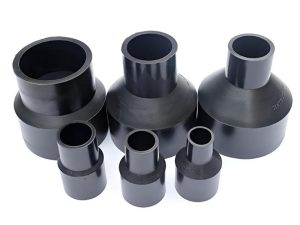
HDPE fitting dimensions standard system
1. International general standards
HDPE fitting dimensions follow a variety of international standards, mainly including:
ISO standards: global general standards established by the International Organization for Standardization
ASTM standards: American Society for Testing and Materials standards
DIN standards: German industrial standards
EN standards: European standards
In China, HDPE fitting dimensions mainly follow national standards such as GB/T 13663-2000 “Polyethylene (PE) pipes for water supply”.
2. Nominal diameter (DN) and outer diameter size
HDPE pipe sizes are expressed in nominal diameter (DN), which is the standardized nomenclature for piping systems:
| Nominal Diameter DN (mm) | Average Outer Diameter (mm) | Minimum Outer Diameter (mm) | Maximum Outer Diameter (mm) |
| 20 | 20.0 | 19.8 | 20.2 |
| 25 | 25.0 | 24.8 | 25.2 |
| 32 | 32.0 | 31.8 | 32.2 |
| 40 | 40.0 | 39.8 | 40.2 |
| 50 | 50.0 | 49.8 | 50.2 |
| 63 | 63.0 | 62.8 | 63.2 |
| 75 | 75.0 | 74.8 | 75.2 |
| 90 | 90.0 | 89.8 | 90.2 |
| 110 | 110.0 | 109.6 | 110.4 |
| 125 | 125.0 | 124.6 | 125.4 |
| 140 | 140.0 | 139.6 | 140.4 |
| 160 | 160.0 | 159.6 | 160.4 |
Table: Comparison table of nominal diameter and outer diameter of common HDPE pipe fittings

Main types and size parameters of HDPE pipe fittings
1. Elbow size specifications
HDPE elbows are used to change the direction of the pipeline. Common angles are 45° and 90°:
90° elbow size parameters:
Bending radius (R): usually 1.5×DN or 1.0×DN
Center to end face dimension (C): varies according to the bending radius
Wall thickness: the same as or slightly thicker than the corresponding pipe material
45° elbow size parameters:
Bending radius: usually 1.5×DN
Center to end face dimension: about 0.7 times that of 90° elbow
2. Tee size specifications
HDPE tees are divided into equal diameter tees and reducing tees:
Main dimensions of equal diameter tees (T-type):
Diameter of main pipe (D1) = diameter of branch pipe (D2)
Distance from the center of branch pipe to the end face of main pipe (H): varies according to DN
Overall length (L): usually 3×DN
Main dimensions of reducing tees:
Diameter of main pipe (D1) ≠ diameter of branch pipe (D2)
Length of reducing transition zone: usually (D1-D2)×2.5
3. Flange connector size
HDPE flange connectors are used to connect with metal pipes or equipment. The size parameters include:
Outer diameter of flange
Diameter of center circle of bolt hole
Number and diameter of bolt holes
Thickness of flange
Common flange standards are:
PN6/PN10 (European standard)
Class150/Class300 (American standard)
4. Pipe cap size specifications
HDPE pipe caps are used to close the ends of pipes. The main size parameters are:
Inner diameter: matches the outer diameter of the corresponding pipe material
Depth: usually 1.5 times the DN
Wall thickness: the same as or slightly thicker than the corresponding pipe material

HDPE fitting dimensions measurement method
1. Outer diameter measurement
Steps to correctly measure the outer diameter of HDPE pipe fittings:
Use a calibrated digital caliper or π ruler
Measure three points in the vertical direction of the pipe fitting port
Take the average value as the final measurement result
Make sure the measurement position is at least 10mm away from the port
2. Wall thickness measurement
Notes on wall thickness measurement:
Use an ultrasonic thickness gauge or a dedicated wall thickness caliper
Measure at least four equally divided points
Record the minimum value as a control parameter
Avoid measuring at ribs or structural changes
3. Length measurement
Key points for measuring the length of pipe fittings:
Use a steel tape measure or laser distance meter
For elbows, measure the distance from the center to the end face
For tees, measure the vertical distance between each port
Consider the effect of temperature on the measurement results (thermal expansion and contraction)
HDPE fitting dimensions selection guide
1. Select pipe diameter according to flow requirements
When selecting HDPE fitting dimensions, the following factors should be considered:
Design flow (m³/h)
Allowable flow rate (m/s): usually 1-2m/s
Pressure loss requirements
Future expansion possibilities
Simple flow-pipe diameter comparison table:
| Flow Rate (m³/h) | Recommended Minimum DN (mm) |
| 0–5 | 20 |
| 5–10 | 25 |
| 10–20 | 32 |
| 20–40 | 40 |
| 40–70 | 50 |
| 70–120 | 63 |
| 120–200 | 75 |
| 200–320 | 90 |
| 320–500 | 110 |
| 500–800 | 125 |
| 800–1200 | 140 |
| 1200–1800 | 160 |
2. Pressure level matching
The pressure level of HDPE pipe fittings is usually divided into:
PN6 (0.6MPa)
PN8 (0.8MPa)
PN10 (1.0MPa)
PN12.5 (1.25MPa)
PN16 (1.6MPa)
When selecting, ensure that the pressure level of the pipe fittings is not lower than the design pressure of the pipeline system.
3. Temperature effect correction
The size of HDPE material will change with temperature, and the temperature correction coefficient is about 0.15mm/(m·℃). When used in high temperature environment, consider reserving appropriate expansion gap.

HDPE fitting dimensions tolerance and quality control
1. Dimension tolerance standard
Allowable tolerance range of HDPE fitting dimensions:
Outer diameter: ±0.3%DN (usually ±0.3mm to ±1.5mm)
Wall thickness: +12%/-10%
Length: ±5mm (≤500mm) or ±0.5% (>500mm)
Angle: ±0.5° (elbow, tee)
2. Common dimensional defects and treatments
Common dimensional problems of HDPE pipe fittings:
Excessive ovality: The difference between the maximum and minimum values of the outer diameter measurement is >1%DN
Handling: Return or downgrade
Uneven wall thickness: The minimum wall thickness of the same section is <90% of the nominal value
Handling: It cannot be used for pressure pipes
Insufficient length: Affects the installation seal
Handling: Use compensators or replace pipe fittings
3. Key points of quality control
Measures to ensure the dimensional quality of HDPE pipe fittings:
Incoming inspection: Sampling and measuring key dimensions by batch
Process control: Monitoring of injection molding parameters
Factory inspection: 100% appearance inspection, sampling and dimensional inspection
Third-party certification: such as ISO 9001 quality management system
Key points for installation of HDPE pipe fittings
1. Dimension control of hot-melt butt welding
Key dimensional parameters of hot-melt butt welding:
Welding flange width: 0.5-1×wall thickness
Welding pressure: 0.15-0.3MPa
Heat absorption time: calculated according to wall thickness (about 10s/mm)
Switching time: ≤5s
Cooling time: 2-4min/wall thickness (mm)
2. Dimension requirements for electric fusion connection
Dimension control of electric fusion pipe fittings installation:
Gap: 0.1-0.3mm (limiter required)
Insertion depth: ±1mm from marking line
Misalignment: ≤10% wall thickness
3. Flange connection size matching
Key points for flange connection installation:
Bolt hole centering deviation: ≤1mm
Flange parallelism: ≤0.5mm
Gasket compression: 25-30%
Bolt torque: applied according to standard grades
The correct selection and strict control of HDPE fitting dimensions are the basis for ensuring the safe and reliable operation of the pipeline system. Engineers and installers should fully understand the size standards, measurement methods and installation requirements of various HDPE pipe fittings, and make reasonable choices based on actual project conditions.


