

Core features of HDPE drainage fittings
Material advantages
Density 0.95-0.97g/cm³, molecular weight > 250,000
Acid and alkali resistance range pH2-12 (ASTM D543 standard test)
Working temperature -40℃ to 80℃ (short-term peak 100℃)
Mechanical properties
| Property | Test Standard | Typical Value |
| Tensile Strength | ISO 527 | ≥22 MPa |
| Impact Strength | ISO 179 | No breakage (-20°C) |
| Ring Stiffness | ISO 9969 | Above SN8 grade |
Hydraulic characteristics
The inner wall roughness coefficient is only 0.009 (new cast iron pipe is 0.015), and the flow loss is 30-40% lower than that of metal pipes

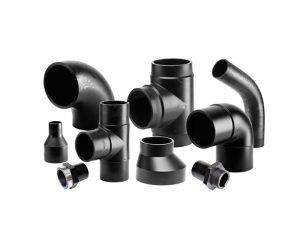
Mainstream accessory types and technical parameters
1. Connection accessories
Socket joint
DN110 specification insertion depth ≥115mm, rubber ring hardness (IRHD) 65±5
Electric fusion sleeve
Copper wire resistance value 0.8-1.6Ω/m, fusion time (DN200) 210±10 seconds
Flange conversion joint
PN6 pressure level, bolt hole spacing according to ISO 7005 standard
2. Steering accessories
| Type | Bending Radius | Pressure Loss Coefficient |
| 45° Elbow | 1.5D | 0.35 |
| 90° Long Radius Elbow | 3D | 0.5 |
| Tee (Branch Flow) | – | 1.8 |
3. Maintenance accessories
Clean-up port
Openable angle ≥120°, sealing pressure 0.5 bar
Manhole connector
Axial adjustment ±15°, radial displacement compensation 5% pipe diameter
Breath cap
Ventilation volume ≥30L/s (under DN100 condition)
Industry application scenario analysis
1. Municipal drainage system
Rainwater and sewage diversion pipe network (blue/green logo required)
Underpass railway casing (SN16 ring stiffness required)
Pump station inlet and outlet pipes (1.5 times the water hammer pressure resistance)
2. Building drainage
High-rise building drainage riser (energy dissipation elbow shock absorption design)
Siphon rainwater system (special HDPE anti-negative pressure accessories)
Basement pressure drainage (flange-type reinforced connection)
3. Industrial drainage
Chemical wastewater pipeline (including anti-UV additives)
Mine drainage system (wear-resistant layer thickness ≥ 3mm)
Food factory drainage (compliant with FDA 21 CFR standards)
Key points of installation process
Hot-melt connection
Temperature control: 210±10℃ (PE80 material)
Welding pressure: 0.15-0.3MPa (adjusted according to pipe diameter)
Cooling time: ≥ pipe wall thickness (mm) × 1.5 (minutes)
Sealing test
Test pressure = 1.5×working pressure (minimum 0.2MPa)
Pressure holding time: ≥30 minutes for DN≤300, 10 minutes for every 100mm increase
Trench construction
Width = pipe diameter + 400mm (mechanical excavation)
Foundation cushion: 5-20mm crushed stone, thickness ≥150mm
Backfill compaction: ≥90% within 50cm of pipe top

Quality control standards
International certification
ISO 4437: PE pipe system for drainage
ASTM F714: Standard for polyethylene pressure pipes
EN 1519: Special standard for building drainage
Key test items
Melt index (190℃/5kg): 0.2-0.4g/10min
Oxidation induction time (200℃): ≥20 minutes
Carbon black content: 2.5±0.5% (UV protection)
Life assessment
Predicted by ASTM D2837 method:
20℃/50 years strength retention rate>85%
Life in chemical corrosion environment>30 years
Compared with traditional materials
| Characteristic | HDPE Fittings | Cast Iron Fittings | PVC Fittings |
| Connection Reliability | Molecular-level fusion | Mechanical connection | Adhesive-dependent |
| Acid & Alkali Resistance | Full pH range | Requires internal lining | Not resistant to strong acids |
| Flow Efficiency | 35% improvement | Baseline | 15% improvement |
| Installation Speed | 3 times faster | Baseline | 1.5 times faster |
| Life Cycle Cost | 40% lower | Baseline | 20% lower |
How to choose?
Determine the working conditions
→ Pressure requirements? → Select SDR value
→ Chemical contact? → Select material grade
→ Buried depth? → Determine ring stiffness
Connection method selection


