

In modern mining engineering, pipeline systems are one of the core infrastructures for mine production and tailings management. With the continuous advancement of ore processing technology, the requirements for pipeline materials are also increasing: they must not only be wear-resistant and corrosion-resistant, but also maintain long-term stable operation in extreme environments. Among many pipeline materials, high-density polyethylene (HDPE), with its superior comprehensive performance, especially durable HDPE pipe fittings, has become the preferred solution for mining slurry and tailings transportation systems. Junrui, as a professional HDPE pipe fitting manufacturer, deeply understands the stringent requirements of the mining industry and is committed to providing customers with high-performance, long-life pipe fitting products.
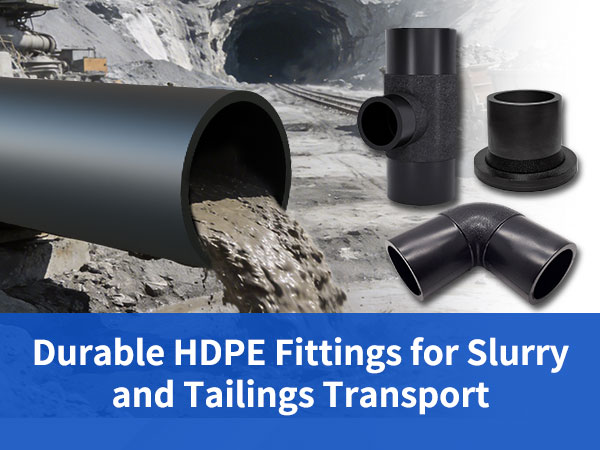
The Stringent Challenges of Mining Slurry and Tailings Transportation Systems
During mining and mineral processing, large quantities of slurry and tailings containing solid particles are generated. These media typically contain hard mineral particles, exhibiting strong abrasiveness and complex chemical composition, placing extremely high demands on pipeline systems:
High Abrasiveness: Solid particles in the slurry cause continuous wear on the pipe walls.
Chemical Corrosion: Acids, alkalis, or other chemical reagents in the slurry can corrode the pipe materials.
Pressure Fluctuations: Pressure fluctuations and shocks occur during long-distance transportation.
Extreme Environments: Mining areas have complex terrain and significant variations in temperature, humidity, and other environmental conditions.
Traditional metal pipes such as steel and ductile iron pipes often perform poorly under these conditions, being prone to corrosion and wear, and also incurring high maintenance costs and short lifespans. In contrast, HDPE pipes offer significant advantages in mining applications due to their unique material properties.

Core Advantages of HDPE Pipe Fittings
1. Superior Wear and Corrosion Resistance
HDPE material itself has a low coefficient of friction and a smooth inner wall, significantly reducing wear when transporting slurries containing solid particles. Compared to steel pipes, HDPE wears less and has a longer lifespan during slurry transportation, meaning less downtime for maintenance and lower replacement costs.
Furthermore, HDPE has natural corrosion resistance to various chemical media and will not be damaged by acid or alkali corrosion like metal pipes, thus ensuring long-term safe operation of the system.
2. Strong, Durable, and Excellent Impact Resistance
HDPE has extremely high impact resistance and good flexibility, enabling it to withstand extrusion, tension, and other external forces in mining environments with significant terrain undulations and temperature variations without easily breaking. Especially when subjected to sudden pressure fluctuations, its fatigue resistance far exceeds that of traditional metal pipes.
3. Welding Technology Ensures System Integrity
Junrui’s HDPE pipe fittings support both hot-melt welding and electrofusion welding technologies, enabling the pipeline system to achieve a seamless, integrated structure at the joints. This welding method not only provides excellent sealing but also eliminates the leakage risks associated with traditional flange connections, significantly improving system reliability and safety.
4. Lightweight and Easy to Install
Compared to steel pipes and concrete pipes, HDPE pipe fittings are lighter, allowing for faster on-site installation, making them particularly suitable for complex terrain in mining areas. Their lightweight nature also reduces transportation costs and construction risks, improving overall project efficiency.
5. Long Lifespan and Low Maintenance Costs
HDPE pipes are typically designed for a lifespan of several decades (depending on the specific application environment), far exceeding that of traditional pipes. A longer service life translates to lower maintenance and replacement costs, helping mining companies reduce overall operating costs and increase return on investment.

Typical Applications of HDPE Pipe Fittings in Mining
Junrui’s HDPE pipe fittings are widely used in the following key areas of mining:
1. Slurry Transport Pipelines: Used to transport slurry generated during mineral processing from the mining area to treatment facilities or tailings ponds. The abrasion resistance of HDPE pipe fittings is particularly important in this application, effectively extending the system’s service life.
2. Tailings Slurry Transportation: Tailings slurry contains a large number of fine particles, posing extremely severe abrasion to pipelines. The corrosion resistance and abrasion resistance of HDPE pipe fittings significantly reduce the risk of pipeline breakage, ensuring the safe discharge of tailings.
3. Wastewater and Recycled Water Systems: Wastewater and recycled water generated during mining operations require stable transportation and recycling. HDPE pipe fittings also perform exceptionally well in these systems.
Junrui’s Advantages in HDPE Pipe Fittings Manufacturing for the Mining Industry
As a professional HDPE pipe fitting manufacturer, Junrui not only provides standard products but also customized solutions based on the needs of mining projects. Our advantages include:
A rigorous quality control system: ensuring that every product meets international standards and customer requirements.
Extensive industry experience: long-term service to the mining, water conservancy, and industrial transportation sectors, accumulating numerous successful cases.
Technical support and on-site service: providing welding technical guidance, installation advice, and after-sales support to ensure smooth project implementation.
Material optimization and innovation: continuously adopting advanced material formulations and production processes to improve the durability and reliability of pipe fittings.

FAQ
Q1: Why choose HDPE pipe fittings for mining slurry transportation?
A1: HDPE pipe fittings possess excellent wear resistance, corrosion resistance, and impact resistance, and can achieve a leak-free connection through hot-melt welding. These characteristics make them more reliable and economical than traditional metal pipes in slurry transportation systems.
Q2: Can HDPE pipe fittings be used long-term in extreme mining environments?
A2: HDPE pipe fittings have good flexibility and weather resistance, and can operate stably in mining environments with large temperature variations and complex terrain. Their service life far exceeds that of many traditional materials.
Q3: What are the welding methods for HDPE pipe fittings? Which is more reliable?
A3: Common welding methods include hot-melt welding and electrofusion welding. Both can achieve a leak-free connection, but the specific choice depends on the pipe diameter, site conditions, and construction requirements.
Q4: Are HDPE pipe fittings difficult to maintain?
A4: Due to their strong corrosion resistance and wear resistance, HDPE pipe fittings generally require low maintenance. Regular inspections of connections and support points are sufficient, significantly reducing maintenance costs.
Q5: Can Junrui provide customized services for mining projects?
A5: Yes. Junrui can provide customized HDPE pipe fittings and technical support based on specific customer needs, ensuring reasonable system design and efficient construction.
In the field of mining mud and tailings transportation, the reliability of pipeline systems is directly related to production safety, environmental compliance, and cost-effectiveness. HDPE pipe fittings, with their advantages of wear resistance, corrosion resistance, lightweight yet high strength, have become an indispensable core component of modern mining engineering. As a professional manufacturer, Junrui will continue to help global mining customers improve system stability and operational efficiency, achieving safe and sustainable production goals through high-quality products and professional technical services.


