

In today’s industrial, municipal, agricultural, and construction sectors, the reliability, durability, and economy of piping systems are crucial. High-density polyethylene (HDPE) pipe fittings, particularly those in the standard 25mm size (typically corresponding to DN20, or a nominal diameter of 20mm), have become the preferred solution for numerous applications due to their superior overall performance. This article will delve into the core characteristics, main types, applications, installation advantages, and key purchasing considerations of 25mm HDPE pipe fittings, providing a comprehensive analysis of the extraordinary value of this modern engineering material.
Core Features and Advantages
25mm HDPE pipe fittings are not ordinary plastic connectors. Made from high-density polyethylene (HDPE) through advanced injection molding, they inherit all the excellent qualities of HDPE and feature enhanced design for connection performance.
Excellent Corrosion and Chemical Resistance
HDPE is an inert material, resistant to attack by a wide range of chemicals, including acids, alkalis, and salts, and is unaffected by electrochemical corrosion. This means that 25mm HDPE pipe fittings can be used to transport domestic sewage, industrial wastewater, chemical media, and underground applications without the need for additional corrosion protection, resulting in a service life far exceeding that of traditional metal pipe fittings.
Unparalleled Flexibility and Impact Resistance
Unlike brittle materials, HDPE pipe fittings possess excellent flexibility and extremely high impact strength, especially at low temperatures. This property allows them to effectively resist deformation and damage caused by external pressures such as foundation settlement and vehicle overrun, significantly reducing the risk of leaks in piping systems due to external impacts. Excellent hydraulic properties and exceptionally long lifespan.
HDPE pipe has a mirror-smooth inner wall and an extremely low Manning coefficient, minimizing frictional losses when conveying fluids. This allows for greater flow rates within the same pipe diameter, helping to save pumping energy. High-quality 25mm HDPE pipe fittings are designed to last over 50 years at rated temperature and pressure, providing a “set-and-forget” solution.
Reliable connection and sealing.
The core advantage of 25mm HDPE pipe fittings lies in their connection method. Butt fusion or electrofusion allows the pipe and fitting to completely fuse together at the molecular level, creating a 100% leak-free, permanent connection. This connection is even stronger than the pipe itself, completely eliminating the potential leakage risks associated with traditional flange and threaded connections.
Lightweight, high-strength, and environmentally friendly and non-toxic.
HDPE material has a density significantly lower than metal, making 25mm pipe fittings lightweight, easy to transport, handle, and install, significantly reducing labor intensity and construction costs. At the same time, HDPE is a non-toxic material that meets drinking water contact standards, will not cause secondary pollution to the conveying medium, and is 100% recyclable and reusable, making it a truly “green” environmentally friendly product.

25mm HDPE pipe fitting types and applications
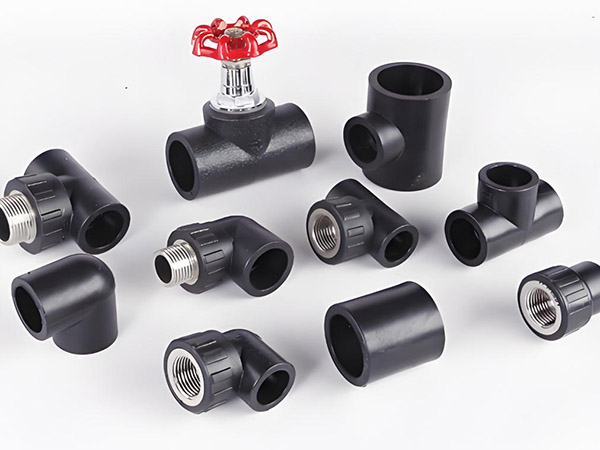
A comprehensive range of 25mm HDPE pipe fittings is available to meet the needs of various complex piping layouts. Common types include:
Elbows: Primarily used to change the direction of a pipe, with 90° and 45° elbows being common. They are core components for achieving pipe diversion.
Tees and crosses: Used to divert and merge fluids, such as T-shaped tees and 45° angled tees, and are key to building branching pipe networks.
Straight fittings/sleeves: Used to connect two pipes of the same specification in a straight line, extending the pipe.
Reducing fittings: Used to connect pipes of different diameters, such as 25mm to 32mm, to achieve a smooth transition.
Flanges: Used to convert HDPE pipe systems to valves, pumps, or other metal equipment that uses flanged connections.
Pipe caps and plugs: Used to seal the ends of pipes, facilitating system testing, maintenance, or reserving interfaces for future expansion. Union/Repair Joint: Used where a detachable connection is required to facilitate the later maintenance or replacement of a specific pipe section.
Widely applicable applications include:
Municipal water supply and drainage systems: Serving as core connectors for cold water supply networks inside and outside buildings, community irrigation networks, and sewage collection networks.
Agricultural irrigation and landscaping: In drip and sprinkler irrigation systems, 25mm fittings are the primary connectors for branch pipes and capillary tubes. Their corrosion resistance makes them particularly suitable for transporting fertilizers and chemicals.
Industrial fluid transport: Used in chemical plants, mines, power plants, and other locations to transport corrosive media, slurries, and circulating water.
Communication cable sheathing: Serving as sheathing for optical and electrical cables and protecting their connections, they provide excellent moisture resistance, insulation, and mechanical protection.

Installation Process: Simple, Efficient, and Reliable
Electrofusion:
This is the most common and convenient connection method. Resistance wire is embedded within the pipe fitting. Using a dedicated electric fusion welding machine, heating and cooling times are automatically controlled by scanning a barcode on the fitting or manually entering parameters. The entire process is highly automated, requiring relatively little operator skill, effectively ensuring consistent and stable connection quality. It is particularly suitable for construction sites with limited space and emergency repairs.
Butt Fusion:
Suitable for applications requiring higher joint strength. Using a dedicated butt fusion welding machine, the ends of the pipe and fitting are simultaneously heated to a molten state, then rapidly pressure is applied to fuse them together. The resulting joint is as strong as the pipe itself. This method eliminates the need for additional fittings, but does require a larger operating space and specialized equipment.
Either method achieves molecular fusion, forming a permanent, integrated structure unmatched by any mechanical connection.

How to Choose High-Quality 25mm HDPE Pipe Fittings
Raw Material Grade: Prefer fittings made from PE100 or PE100RC grades. PE100RC offers higher long-term hydrostatic strength and resistance to environmental stress cracking, resulting in superior performance.
Brand and Qualifications: Choose a reputable brand and verify that the product has relevant health permits (for drinking water use), ISO quality management system certification, and test reports.
Appearance Quality: High-quality fittings should have smooth inner and outer surfaces, uniform color, and be free of bubbles, cracks, obvious impurities, and scratches. The copper coils of electric fusion fittings should be evenly distributed, with no exposed or displaced copper.
Specification Compatibility: Confirm that the fitting’s dimensional standards (such as SDR and nominal pressure PN) fully match the 25mm HDPE pipe you are using to ensure welding quality and system pressure resistance.
Supporting Services: Whether the supplier can provide professional technical support, installation guidance, and comprehensive after-sales service is also an important consideration.
Although 25mm HDPE pipe fittings are small components, they are the cornerstone of building an efficient, reliable and long-lasting modern piping system.


