

Polyethylene (PE) pipe fittings are an indispensable connection component in the HDPE pipeline system. The 2 inch (about DN50) specification has become a common pipe fitting in the municipal, agricultural and industrial fields due to its moderate size and wide application scenarios. This article will comprehensively analyze the key knowledge of 2-inch polyethylene pipe fittings from the aspects of type, material, price, selection, installation, etc., to help users choose and use them correctly.
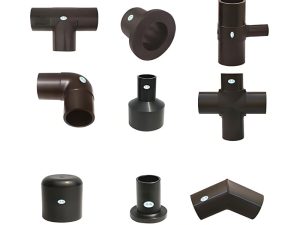
Overview of 2-inch polyethylene pipe fittings
1. What are 2-inch polyethylene pipe fittings?
Specifications: Nominal diameter DN50 (outer diameter about 63mm), in line with ISO 4427, GB/T 13663 and other standards.
Material: High-density polyethylene (HDPE), divided into PE80 and PE100 grades, the latter has higher strength.
Use: Used for connection, diversion, diversion, diameter change, etc. of HDPE pipes, suitable for water supply, drainage, gas, irrigation and other systems.
2. Main types and functions
| Type | Function | Common Application Scenarios |
| Coupling | Connects two pipes of the same diameter | Pipeline extension, repair |
| Elbow (45°/90°) | Changes the direction of the pipeline | Bypassing obstacles, directional installation |
| Tee / Cross | Diverts or combines flow | Branch water supply, drainage systems |
| Flange Joint | Connects HDPE pipe to metal/valve equipment | Pump stations, water treatment equipment |
| Reducer | Connects pipes of different diameters | Network expansion, equipment interface |
| End Cap | Seals the end of the pipe | Temporary sealing, pipeline testing |

2-inch polyethylene pipe price analysis
1. Price range (market conditions in 2025)
| Type | Price Range (CNY/pc) | Influencing Factors |
| Coupling | 5–15 | Material (PE80 / PE100) |
| 90° Elbow | 8–20 | Pressure Rating (PN6 / PN10 / PN16) |
| Tee | 10–25 | Manufacturing Process (Injection / Extrusion) |
| Flange Joint | 15–40 | Flange Material (HDPE / Stainless Steel) |
| Reducer | 12–30 | Reduction Ratio (e.g., DN50 → DN40) |
2. Key factors affecting price
Material grade: PE100 is 10%-20% more expensive than PE80, but has stronger pressure bearing capacity.
Pressure bearing standard: PN10 (1.0MPa) pipe fittings are 15%-30% more expensive than PN6 (0.6MPa).
Purchase volume: Bulk purchases usually enjoy certain discounts.

How to choose the right 2-inch PE pipe fittings?
1. Select the material according to the purpose
Water supply/food grade: Use blue PE100 pipe fittings that meet the GB/T 17219 standard.
Gas: Yellow pipe fittings that meet the GB 15558.2 standard must be added with anti-ultraviolet agent.
Drainage/chemical: Black PE pipe fittings are optional, resistant to acid and alkali corrosion.
2. Select the pressure grade according to the pressure requirement
| Pressure Rating | Application Scenarios | Recommended Fitting Types |
| PN6 (0.6 MPa) | Low-pressure irrigation, drainage | Standard PE80 couplings and elbows |
| PN10 (1.0 MPa) | Municipal water supply, medium-pressure networks | PE100 tees and flange joints |
| PN16 (1.6 MPa) | High-pressure water transport, industrial pipelines | Reinforced PE100 fittings |
3. Connection method selection
Hot-melt butt welding: suitable for large-diameter pipes, high connection strength, and requires professional equipment.
Electrofusion connection: easy to operate, suitable for small pipe diameters (such as DN50), but the cost is relatively high.
Mechanical connection: flange or clamp type, detachable, suitable for temporary projects.

Installation precautions
1. Key points of hot-melt welding process
Temperature control: 200-220℃, avoid overheating and material degradation.
Butt welding time: DN50 pipe fittings are recommended to be heated for 30-40 seconds and cooled for ≥5 minutes.
Cleaning treatment: Before welding, remove oil and moisture from the pipe end to ensure that the welding surface is flat.
2. Common installation errors and avoidance methods
❌ Error 1: Direct welding without alignment → causes eccentricity of the interface and easy leakage.
✅ Correct approach: Use a clamp to fix and ensure concentricity.
❌ Error 2: Insufficient cooling time → Reduced welding strength and easy cracking.
✅ Correct approach: Strictly cool according to the standard and avoid external disturbance.
❌ Error 3: Mixing pipes of different materials → The welding performance of PE80 and PE100 is very different.
✅ Correct approach: Unify the material grade and avoid mixing.
2-inch polyethylene pipe fittings are key components of the HDPE pipe system. Correct selection and installation directly affect the life of the system. Recommendations:
Choose materials according to purpose (water supply/gas/drainage);
Match pressure level (PN6/PN10/PN16);
Standardize welding process to avoid installation defects;
Bulk purchase is more economical, and PE100 grade pipe fittings are preferred.


