

In the complex web of modern architecture, municipal engineering, and home renovations, a system of white piping, made of polyvinyl chloride (PVC) as its core material, silently carries out a vital mission. And it is the diverse and diverse functions of white PVC pipe fittings that cleverly connect these pipes, creating an efficient and reliable network. Though unassuming, these fittings are the essential “joints” and “hubs” of the entire system, ensuring the smooth and safe flow of water, gas, and other fluids.
Why Choose White PVC Pipe Fittings?
White PVC pipe fittings are the global leading choice due to their unparalleled advantages:
Excellent Corrosion Resistance: PVC effectively resists corrosion from a variety of chemicals, including water, acids, alkalis, and salts. Unlike metal pipes, it resists rust and scaling, significantly extending the service life of the system and making it particularly suitable for conveying domestic water and chemical fluids.
Lightweight and Portable, Easy Installation: Its density is much lower than that of metal, resulting in a lighter weight, significantly reducing the effort and cost of transportation and installation. Installation typically requires only specialized PVC glue (a solvent-based adhesive), making it quick and easy, without the need for heavy equipment or complex welding.
Smooth Interior, Low Fluid Resistance: White PVC pipe has an exceptionally smooth interior with a low coefficient of friction, significantly reducing resistance during fluid transfer, increasing flow rate and efficiency. It also resists the accumulation of scale and impurities, maintaining clean water quality.
Excellent Mechanical Strength and Durability: Despite its light weight, PVC offers excellent impact resistance and pressure resistance, meeting the pressure rating requirements of most household and commercial applications. Its service life is over 50 years.
Affordable and cost-effective: The wide availability of raw materials and relatively low production costs make white PVC pipe fittings one of the most cost-effective piping solutions.
Insulating and environmentally friendly: PVC is a poor conductor of electricity and heat, making it safe to use. Furthermore, modern food-grade PVC materials (such as UPVC) are non-toxic and odorless, meeting drinking water transport standards. PVC is also recyclable, aligning with sustainable development.
Elegant and clean: The pure white appearance creates a neat and clean appearance. When installed exposed (e.g., in laboratories and bathrooms), it blends in beautifully and elegantly.

White PVC pipe fittings: Types and Functions
White PVC pipe fittings come in a wide variety of shapes and styles, each designed for specific connection and diversion requirements. They can be primarily categorized as follows:
Connectors: Provide basic pipe extensions and docking.
Straight connectors/sleeves: Used to connect two pipes of the same diameter in a straight line.
Diverters: Change the direction of fluid flow.
90° elbows: Provide right-angle diversions.
45° elbows: Provide 45-degree diversions, slowing down flow changes and reducing water hammer.
22.5° elbows: Provide for more gradual angle adjustments.
Branches: Divert flow from the main pipe to create a branch.
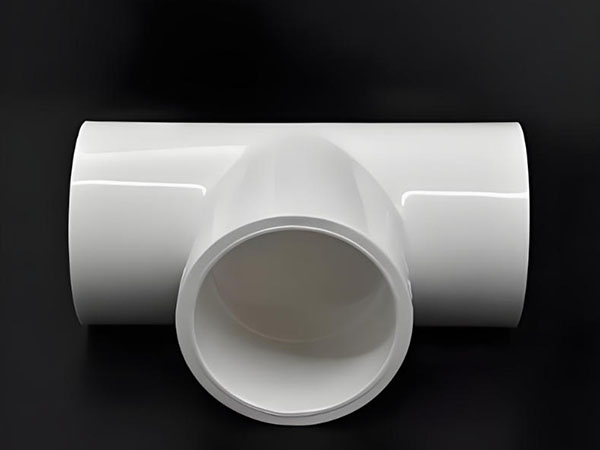
Tees: Create connections in three directions, including equal-diameter tees and reducing tees (one end has a different diameter).
Crosses: Create connections in four directions, suitable for more complex network layouts.
Y-tees/angled tees: Branch pipes are angled relative to the main pipe, allowing for smoother flow diversion and reducing resistance. Reducers: Connect pipes of different diameters to achieve flow control.
Reducing joints: Used for direct pipe-reducing connections with different diameters at both ends.
Reducing tees: Provide pipe-reducing connections at branches.
End treatment and repair fittings: Used to seal pipes or facilitate future maintenance.
Pipe caps: Welded onto pipe ends for permanent closure.
Plugs/plugs: Inserted into the end of a pipe fitting for temporary or removable closures.
Unions: Removable fittings with a central sealing ring, allowing for future maintenance and replacement of pipe sections without cutting.
Auxiliary fittings:
Flanges: Bolted to flanged valves or equipment.
Adapters: Used to convert PVC pipe to other types of pipe (such as PPR or metal pipe).

Applications
Civil Construction: Hot and cold water supply and drainage systems, and rainwater systems in residential and apartment buildings.
Municipal Engineering: Municipal water supply and drainage networks, and parts of the piping systems within sewage treatment plants.
Agricultural Irrigation: Connecting branch pipes and capillary tubes in greenhouse drip and sprinkler irrigation systems.
Landscaping: Water features, fountains, and irrigation systems in parks and gardens.
Industrial: Transporting certain metal-corrosive chemicals and ventilation and exhaust lines.
Swimming and Spa: Piping connections for pool circulation and filtration systems.
Home and DIY: Fish tank filtration, small craft projects, etc.

Selection and Installation Guide
Correct Selection:
Size Matching: Select fittings strictly based on the pipe’s outside diameter (OD) or nominal diameter (DN) to ensure a perfect size match.
Pressure Rating: Check the pressure rating marked on the fitting (e.g., PN 1.0, PN 1.6) to ensure it meets the system’s operating pressure requirements.
Material Standards: When used in drinking water systems, be sure to select UPVC fittings that meet national health standards and are marked “food grade” or “for drinking water.”
Professional Installation:
Cutting and Cleaning: Use a dedicated PVC pipe cutter or fine-tooth saw to ensure a flush, burr-free cut. Before bonding, use a dry cloth to clean dust, moisture, and oil from the pipe and fitting joints.
Gluing: Use purple or clear quick-drying glue specifically for PVC. Use a brush to apply the glue evenly and generously to the outside of the pipe and inside of the fitting socket. Avoid excessive thickness.
Connecting and Curing: Quickly insert the pipe into the fitting socket, rotating it a quarter turn to ensure even distribution of the glue, and maintain pressure for more than ten seconds to prevent it from popping out. After bonding, allow the adhesive to rest for a period of time (depending on the adhesive instructions and ambient temperature, typically 15-30 minutes for initial curing and 24 hours for full strength) before performing a water pressure test.
Safety Warning: This operation should be performed in a well-ventilated environment, away from open flames, and while wearing gloves and goggles.


