

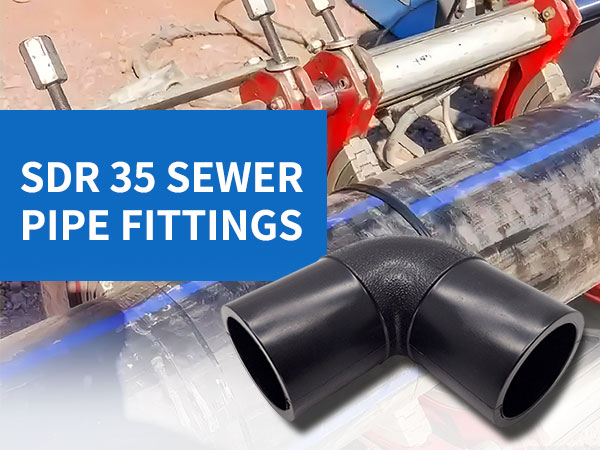
SDR 35 Sewer Pipe Fittings are widely used plastic pipe fittings in municipal sewage, stormwater drainage, and building external underground drainage systems. They are typically used in conjunction with SDR 35 PVC sewage pipes to form a complete gravity flow drainage system.
Understanding the structural characteristics, dimensional system, and application advantages of SDR 35 pipe fittings is crucial for engineering design, construction, installation, and product export.
What is SDR 35?
SDR (Standard Dimension Ratio) is a parameter representing the ratio of a pipe’s outer diameter to its wall thickness:
SDR = Outer Diameter / Wall Thickness
SDR = Outer Diameter / Wall Thickness
SDR 35 indicates that the pipe’s outer diameter is 35 times its wall thickness; therefore, it belongs to the category of thin-walled gravity flow drainage pipes and is not used in high-pressure water supply systems.
Features of the SDR 35 piping system: Lightweight design; Specifically designed for unpressurized or low-pressure drainage; Typically uses socket-type rubber ring seals; Conforms to ASTM D3034 standard (commonly used in North America).
What are SDR 35 Sewer Pipe Fittings?
SDR 35 Sewer Pipe Fittings are PVC fittings that are fully compatible with SDR 35 pipe sizes and are used for:
changing flow direction
pipe branching
diameter transitions
system inspection and maintenance
These fittings are also non-pressure designed and primarily serve gravity-flow sewage and stormwater drainage systems.
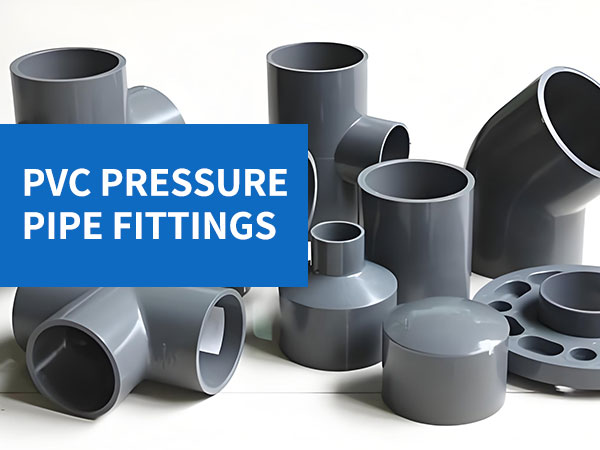
Common SDR 35 Fitting Types
1. Elbow/Bend
Used to change pipe direction, it is one of the most commonly used sewage fittings.
Common Angles:
22.5° Elbow
45° Elbow
90° Long Radius Elbow
Sewage systems typically use long radius elbows to reduce sewage flow resistance and lower the risk of clogging.
2. Tee/Wye
Used for branch pipe connections to the main pipe.
Sanitary Tee: Vertical or horizontal branch
Wye: Smoother 45° branch connection, more commonly used in drainage systems
In sewage systems, wyes are better at preventing backflow and sedimentation than standard right-angle tees.
3. Reducer
Used for transition connections between different pipe diameters, such as from a 6″ pipe to a 4″ pipe, ensuring progressive flow matching in the system.
4. Cleanout Fitting: Used for later maintenance and unclogging, it is an important component of the sewage system. It is commonly installed at:
Pipe bends
Near building exterior walls
In the middle of long straight pipe sections
5. Coupling/Repair Coupling: Used to connect two pipe sections or repair damaged pipes.
SDR 35 Fittings Size System
SDR 35 drain fittings use imperial nominal sizes (NPS). Common sizes include:
| Nominal Size | Common Uses |
| 4″ | Main residential sewer line |
| 6″ | Small municipal branch lines |
| 8″ | Urban drainage branch lines |
| 10″–15″ | Municipal main sewer lines |
Because it uses a socket-type rubber ring connection, the socket size of the pipe fitting must be precisely matched with the outer diameter of the SDR 35 pipe to ensure a reliable seal.
Key Advantages of SDR 35 Pipe Fittings:
1. Lightweight and Easy to Install: Compared to concrete or cast iron sewage pipes, SDR 35 PVC pipe fittings are lighter, more efficient to install, and have lower construction costs.
2. Corrosion Resistant and Long Lifespan: PVC material will not corrode due to sewage, soil chemicals, or underground moisture, and has a service life of over 50 years.
3. Smooth Inner Wall and High Drainage Efficiency: The smooth inner surface reduces dirt adhesion, lowers the risk of clogging, and improves drainage capacity.
4. Flexible Joints to Adapt to Ground Settlement: The rubber ring sealing joints have a certain degree of flexibility, which can adapt to slight ground settlement or vibration, reducing the risk of joint cracking.

Typical Application Areas
SDR 35 Sewer Pipe Fittings are primarily used for:
Municipal sewage networks
Stormwater drainage systems
External underground drainage systems
Sewage systems in schools, hospitals, and commercial areas
Not suitable for high-pressure water supply or hot water systems.
Selection and Installation Considerations
Ensure compatibility with SDR 35 pipes; do not mix with SCH pipes.
Prioritize long-radius elbows for bends.
Properly design cleanout ports for easy maintenance.
Clean and lubricate rubber rings before installation.
Ensure sufficient pipe slope for smooth gravity flow.
SDR 35 Sewer Pipe Fittings are an indispensable component of modern sewage systems. With their lightweight, corrosion resistance, ease of installation, and excellent hydraulic performance, they have become the mainstream choice for municipal and building drainage projects.
Correctly selecting the appropriate size and type of SDR 35 fittings not only improves drainage efficiency but also significantly reduces maintenance costs and ensures long-term stable system operation.


