

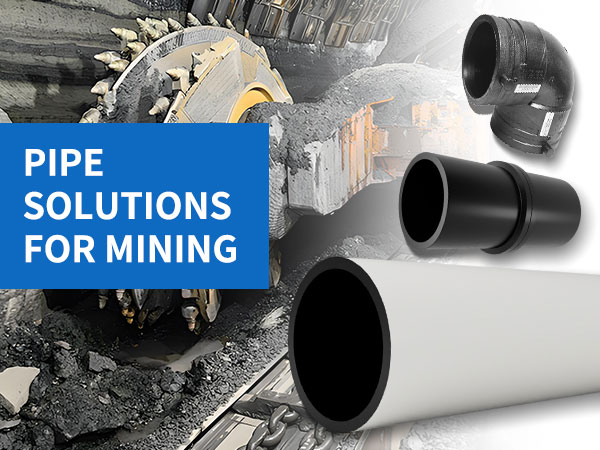
In the processes of mining, mineral processing, and tailings transportation, pipeline systems are critical infrastructure for ensuring production continuity and safety. Whether it’s slurry transportation, tailings discharge, process water circulation, or mine drainage systems, extremely high demands are placed on the wear resistance, pressure resistance, sealing performance, and installation reliability of pipelines. Therefore, selecting appropriate Pipe Solutions for Mining, especially reliable pipeline connection methods and high-quality mining fittings, has become an important prerequisite for the successful operation of mining projects.
The stringent requirements of mining conditions on pipeline systems:
Compared to municipal or agricultural pipelines, mining pipelines operate under high wear, high impact, high pressure, and complex environments, facing the following challenges:
Slurries contain a large number of solid particles, causing severe wear on the inner walls of the pipeline.
Long-distance transportation places extremely high demands on the sealing and stability of connections.
Complex mining terrain presents settlement, vibration, and displacement.
Harsh installation and maintenance environments require high construction efficiency and reliable connections.
This necessitates that mining pipeline solutions be designed systematically from three levels: pipe material selection, connection methods, and fitting installation.
Overview of Common Piping Solutions in the Mining Industry
Common piping materials in the mining industry include:
HDPE Mining Pipe: Abrasion-resistant, flexible, and impact-resistant, suitable for slurry and tailings transportation
Steel-lined plastic pipes: Balancing strength and corrosion resistance
Abrasion-resistant composite pipes: Used in high-wear conditions
Among these, HDPE piping systems have become one of the mainstream choices in mining projects due to their excellent overall connection performance. Their core advantages lie in the integrity of the pipe connection methods and fitting systems.
Detailed Explanation of Mining Piping Connection Methods (Core Advantages)
1. Butt Fusion/Electrofusion
Butt fusion is one of the most common and reliable connection methods for HDPE pipes in mining.
Advantages and Features:
Pipe and fittings form an integrated connection
Connection strength is higher than the pipe material itself
Smooth inner wall, no steps, reducing slurry deposition
Suitable for high-pressure, long-distance slurry transportation
In main mining pipelines and tailings pipelines, butt fusion has almost become the preferred standard solution.
2. Electrofusion Fittings: Electrofusion fittings achieve a high-strength connection between pipes and fittings through heating with an internal resistance wire.
Applicable Scenarios: Areas with limited construction space; Pipeline repair or renovation projects; Underground or mine pipelines.
Advantages: Relatively simple installation; Stable connection quality and strong controllability; Particularly suitable for complex mining conditions.
3. Flange Connections: Flange connections are commonly used at the interface between mining pipelines and pumps, valves, and metal equipment.
Features: Easy to disassemble and maintain; Suitable for equipment connection nodes; Can be flexibly connected to steel pipe systems; Usually used in combination with thermofusion or electrofusion connections to form a complete mining pipeline system.
The Crucial Role of Mining Pipe Fittings in Piping Systems
Mining pipe fittings are not merely “connectors,” but rather the structural and functional core of the entire system.
Common Types of Mining Pipe Fittings:
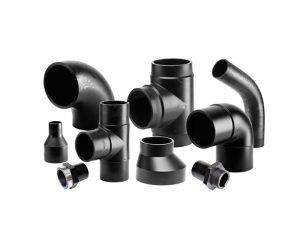
Mining Elbows: Adapt to complex routing in mining areas
Mining Tees/Crosses: Enable multi-branch flow distribution
Reducers: Meet different flow rate requirements
Stub Ends: Connect pump stations and equipment
Electrofusion Fittings: Used for high-risk connection points
High-quality mining pipe fittings must possess:
Same material as the pipe (e.g., HDPE to HDPE)
Excellent wear and pressure resistance
Precise dimensions to ensure the quality of hot-melt or electrofusion fusion

Key Points for Installation and Connection of Mining Pipe Fittings
1. Pre-installation Preparation
Check that the pipe and fitting dimensions and pressure ratings match.
Clean the connection surfaces to avoid impurities affecting welding quality.
Pre-lay out the pipeline according to design requirements.
2. Standardized Connection Construction
Strictly control the heat fusion temperature, time, and pressure.
Electrofusion connections require a matching controller.
Flange connections require even tightening of bolts.
3. System Testing
Perform a pressure test after installation.
Check all pipe fitting connections for leaks.
Ensure the stable operation of the slurry transport system.
The Value of a Complete Mining Piping Solution
Through scientific pipe selection + reliable connection methods + high-quality mining pipe fittings, mining projects can achieve:
Reduced leakage and downtime risks
Extended pipeline system lifespan
Improved transport efficiency and reduced maintenance costs
Enhanced overall mine operational safety
Pipe Solutions for Mining is more than just providing pipe products; it’s a systematic solution centered around mining pipe connections and fitting installation. In the high-wear, high-risk mining environment, only by paying attention to every connection detail can the long-term, safe, and stable operation of the mining pipeline system be ensured.


