

Preparations before installing HDPE reducing tees
1. Review of construction drawings and technical documents
(1) Carefully check the piping system direction, elevation and slope requirements in the design drawings
(2) Confirm that the specifications and models of the reducing tees match the pipe size (such as 160×110mm, 200×160mm, etc.)
(3) Check whether the installation position and direction of the reducing tee in the pipe system are correct
(4) Organize a design briefing meeting to understand the design intent and resolve drawing questions
2. Material acceptance and inspection
(1) Check whether the product certificate, quality certification documents and specification markings are complete
(2) Visually inspect the internal and external surface quality of the reducing tee:
No defects such as bubbles, cracks, dents
Uniform color
The port is flat and has no deformation
(3) Dimension measurement:
Use a caliper to measure the diameter and wall thickness of each port
Confirm that the tolerance meets the GB/T13663.2-2018 standard
Check the matching dimensions of the socket and the spigot
(4) Matching pipe inspection:
Confirm that the SDR value and pressure level match
It is recommended to use products of the same brand and batch
3. Preparation of construction tools and equipment
(1) Hot melt connection equipment:
HDPE Buttfusion Welding Machine (power matches the pipe fittings specifications)
Hot-melt butt equipment (for large-diameter tees)
Infrared thermometer (range 0-300℃)
(2) Pipe processing tools:
Pipe cutting machine (to ensure the straightness of the cut)
Scraper (to remove the oxide layer)
Chamfering tool (to form a 1×45° chamfer)
(3) Installation auxiliary tools:
Special clamp (fixed positioning)
Marking pen (to mark the insertion depth)
Level, plumb line (to measure the position)
(4) Testing tools:
Multimeter (to detect the continuity of the heating wire)
Pressure testing equipment
Leak detection instrument
4. Preparation of on-site construction conditions
(1) Inspection of the construction site:
Ensure sufficient operating space (≥1.5 times the pipe length)
Check the quality of the trench when laying underground:
The bottom of the trench should be flat and free of sharp objects
Lay a 10-15cm thick sand layer
(2) Control of environmental conditions:
The ambient temperature should be between -5℃ and 45℃
Take protective measures in extreme weather
Avoid outdoor work in rainy and snowy weather
(3) Power supply guarantee:
Check the stability of power supply voltage
Prepare generator backup for field work
(4) Material storage and protection:
Store in a cool place and avoid direct sunlight
Adapt to the site 24 hours in advance in low temperature environment
Keep the connection parts clean and dry
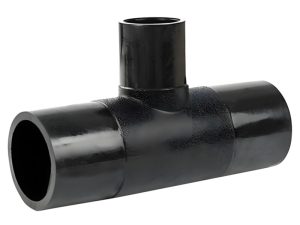
How to Install an HDPE Reducing Tee Correctly
1. Measurement and Positioning
(1) Determine the installation position according to the design drawing:
Use measuring instruments to accurately lay out the lines
Mark the axis position of the main pipe and branch pipe
(2) Consider thermal expansion and contraction factors:
Reserve expansion gap at the fixed bracket
Generally, leave 3-5mm margin for every 10 meters of pipe length
(3) Position accuracy control:
Use a level and plumb line to check straightness
Ensure the verticality of the branch pipe and the main pipe during vertical installation (deviation ≤2°)
(4) Mark the insertion depth:
Usually 2/3 of the socket depth of the pipe fitting
Make a circular mark with a bright marker pen
2. Pipe cutting and processing
(1) Professional cutting operation:
Use a special pipe cutting machine
Ensure that the cut is straight and perpendicular to the pipe axis (tilt deviation ≤ 1% of the pipe diameter)
(2) Cutting of large-diameter pipes:
DN ≥ 160mm is recommended to use a rotary cutting machine
Avoid extrusion deformation
(3) Cutting treatment:
Remove internal and external burrs
Form a 1×45° chamfer for easy insertion
(4) Cutting length control:
10-15mm longer than the design size
Compensate for melting shrinkage
3. Port processing
(1) Oxide layer removal:
Use a special scraper to process
Scraping depth 0.1-0.2mm
Scraping length is 10-15mm longer than the insertion depth
(2) Surface quality requirements:
Show the original color of fresh materials
No visible scratches and contamination
(3) Cleaning treatment:
Wipe with anhydrous alcohol
Remove grease and debris
(4) Electric tee inspection:
Use a multimeter to detect the on-off of the heating wire
Check whether the resistance value meets the manufacturer’s parameters
4. Hot melt connection process
Butt welding (applicable to DN ≥ 90mm)
(1) Equipment installation:
Firmly install the welding machine
Adjust the fixture to keep the coaxial (misalignment ≤ wall thickness 10%)
(2) Heating plate preparation:
Preheat to 200-220℃
Calibrate with infrared thermometer
(3) Welding parameter control:
Welding pressure 0.15-0.25MPa
Observe that the height of the molten flange reaches the specified value
(4) Switching stage:
Quickly remove the heating plate (≤ 5 seconds)
Immediately apply butt pressure
(5 ) Pressure-maintaining cooling:
Maintain pressure until the cooling time is over
Natural cooling, no forced cooling
Electrofusion connection (applicable to DN≤315mm)
(1) Assembly inspection:
Ensure that the pipe is inserted in place
Check the centering (misalignment ≤10% of wall thickness)
(2) Power connection:
Correctly connect the electric fusion welding machine
Set the correct welding parameters
(3) Welding process:
Start the welding program
Monitor the current and voltage stability
(4) Cooling stage:
Keep fixed until completely cooled
No movement or force is allowed
5. Post-installation processing
(1) Appearance inspection:
Check the uniformity of the weld flange
Confirm that there is no false weld or over-welding
(2) Marking and recording:
Record welding parameters
Mark the weld number
(3) Support and fixation:
Install appropriate pipe supports
Avoid stress concentration
(4) Finished product protection:
Prevent mechanical damage
Avoid direct sunlight

Quality inspection and acceptance standards
1. Appearance quality inspection
(1) Inspection of welded parts:
Flange height is uniform and consistent
No defects such as cracks and pores
(2) Dimension deviation inspection:
Coaxiality deviation ≤10% of wall thickness
Angle deviation ≤2°
(3) Marking integrity:
Welding parameter records are complete
Weld joint numbers are clearly identifiable
2. Pressure test
(1) Test pressure:
Generally 1.5 times the working pressure
Minimum not less than 0.8MPa
(2) Pressure stabilization time:
Maintain for at least 30 minutes
Pressure drop does not exceed 5%
(3) Inspection method:
Observe changes in pressure gauge
Check leakage at each connection
3. Completion acceptance documents
(1) Quality certification documents:
Product certificate
Material inspection report
(2) Construction records:
Welding parameter records
Concealed project acceptance records
(3) Test report:
Pressure test report
System flushing and disinfection records
(4) Completion drawings:
Mark actual installation location
Record changes

Common Problem Solving
(1) Welding is not strong:
Check heating temperature and time
Reprocess the connection surface
(2) Position deviation:
Adjust the bracket position
Cut and re-weld if necessary
(3) Leakage problem:
Local repair welding (small defect)
Cut and re-weld (large defect)
(4) Failed electric fusion connection:
Check power supply stability
Confirm that the resistance value is normal
This technical guide is compiled in accordance with relevant national standards and industry best practices. In actual construction, it should be implemented in combination with specific engineering conditions and product manual requirements. Correct installation of HDPE reducer tees is crucial to ensure the safe operation of the pipeline system. It is recommended that it be operated by professionally trained technicians.


