

Overview of HDPE pipe connection accessories
In HDPE (high-density polyethylene) pipe systems, HDPE WYE vs TEE are the most commonly used branch connection accessories, which determine the flow direction of the fluid, the pressure distribution of the system, and the convenience of construction. Choosing the right accessories is crucial to the long-term stable operation of the pipe network.
Basic structure of HDPE WYE vs TEE
| Fitting Type | Structural Features | Fluid Flow Direction | Application Scenarios |
| WYE (Y-type Tee) | 45° or 30° angled branch | Smoother fluid diversion | Sewage, rainwater, media with solid particles |
| TEE (T-type Tee) | 90° vertical branch | Sudden change in direction | Water supply, gas, systems requiring low resistance |
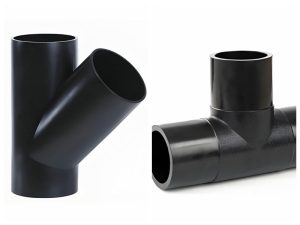
Performance comparison of HDPE WYE vs TEE
1. Fluid mechanics
WYE (Y-type tee)
Advantages: gentle diversion angle (usually 45°), reducing turbulence and pressure loss, suitable for media containing solid particles (such as sewage).
Disadvantages: It takes up a large space and needs to adjust the direction during installation.
TEE (T-type tee)
Advantages: compact structure, suitable for occasions with limited space, simple installation.
Disadvantages: 90° diversion is prone to turbulence, increases local resistance, and may cause sedimentation (not suitable for fluids containing solids).
2. Pressure resistance and sealing
WYE: Due to the gentle diversion angle, the stress distribution is more uniform and the long-term pressure resistance is better.
TEE: In high-pressure systems, right-angle connections may become weak points and need to be strengthened.
3. Construction and maintenance
WYE: Suitable for underground or long-distance pipelines to reduce the risk of blockage.
TEE: More suitable for exposed pipelines, easy maintenance and branch adjustment.

How to choose HDPE WYE or TEE? Key factors analysis
1. Media type
| Medium | Recommended Fitting | Reason |
| Sewage / Slurry | WYE | Reduces clogging, allows smoother flow |
| Water / Gas | TEE | Simple structure, controllable pressure loss |
| Chemical Fluids | WYE (for corrosive media) or TEE (for clean liquids) | Choose based on fluid characteristics |
2. System design requirements
Need low resistance?→ WYE (reduce turbulence)
Limited space?→ TEE (compact structure)
Long-term maintenance-free?→ WYE (not easy to deposit)
3. Installation environment
Underground pipeline: WYE is preferred to reduce the risk of blockage.
Overhead pipeline: TEE is easier to install and adjust.

Actual engineering cases
1. Municipal sewage pipe network (WYE recommended)
Problem: Right-angle TEE is prone to solid deposition and may clog after long-term operation.
Solution: Use 45° WYE to make sewage flow smoother and reduce maintenance frequency.
2. Industrial water supply system (TEE recommended)
Requirement: Quick branching to reduce construction complexity.
Solution: Use TEE with flange connection to facilitate later modification.
| Selection Criteria | WYE | TEE |
| Suitable Media | Fluids with solid particles, high viscosity | Clean liquids, gases |
| Fluid Resistance | Low | Relatively high |
| Installation Space | Requires more space | Compact design |
| Maintenance Requirement | Long-term maintenance-free | May require regular cleaning |
| Cost | Slightly higher | Cost-effective |
Final Recommendation
Choose WYE: If your system transports sewage, slurry or sediment-prone media, or requires long-term stable operation.
Choose TEE: If your system is for water supply, gas supply or requires simple branching, and the space is limited.
By properly selecting WYE or TEE, you can optimize the efficiency of the pipeline system, reduce maintenance costs, and extend its service life.


