

HDPE vs Metal End Caps
Analysis of material properties and protection mechanisms
1. Core properties of HDPE end caps
Molecular structure: linear high molecular polymer, crystallinity of more than 90%
Physical parameters: density 0.945-0.965g/cm³, melting point 130-137℃
Protection mechanism:
Non-polar surface forms a corrosion isolation layer
Molecular chain flexibility absorbs mechanical impact
UV stabilizers provide outdoor protection
2. Material nature of metal end caps
Common types: 304/316 stainless steel, cast iron, aluminum alloy
Crystal structure: face-centered cubic (austenitic steel) and body-centered cubic (ferrite)
Protection principle:
Passivation film formation (stainless steel Cr₂O₃ film)
Sacrificial anode protection (galvanized steel)
Mechanical barrier effect
Performance comparison test data
1. Corrosion protection test (ASTM G31 standard)
| Test Condition | HDPE End Cap | 304 Stainless Steel | Cast Iron End Cap |
| 5% NaCl Solution | No change | Pitting corrosion < 0.1mm | Severe rusting |
| Acidic Environment (pH 2) | Intact | Corrosion 0.3mm | Dissolved and damaged |
| 3-Month Outdoor Exposure | Slight fading | Surface passivation | Extensive rusting |
2. Mechanical protection performance
Impact test (ASTM D256):
HDPE: no breakage (absorbed energy 85J/m)
Cast iron: fracture threshold 15J/m
Compressive strength:
HDPE: 25-30MPa (deformed but not broken)
Stainless steel: 210MPa (permanent deformation)
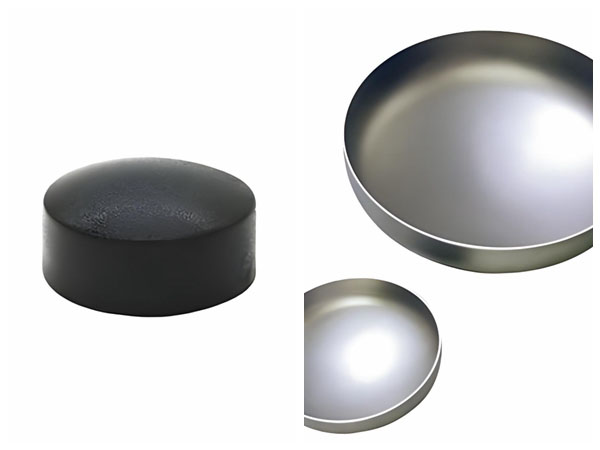
Environmental adaptability study
1. Temperature influence
HDPE application range: -50℃ to +60℃ (80℃ for short term)
Low temperature brittle point: -70℃
Thermal expansion coefficient: 200×10⁻⁶/℃
Metal end cap:
Stainless steel: -200℃ to +800℃
Cast iron: -40℃ to +350℃
2. Special environmental performance
Chemical park:
HDPE has obvious advantages in acid and alkali resistance (pH1-14)
316 stainless steel can only tolerate medium concentrations
Marine environment:
HDPE has the best resistance to salt spray corrosion
Super duplex stainless steel is required to be comparable
Economics and life cycle assessment
1. Cost analysis (taking DN200 end cover as an example)
| Item | HDPE | 304 Stainless Steel | Cast Iron |
| Unit Price | ¥85 | ¥320 | ¥180 |
| Installation Cost | 30% lower | Standard | 20% higher |
| Maintenance Cycle | 10 years | 5-8 years | 3-5 years |
2. Life cycle cost model (20-year service life)
HDPE total cost: initial + 2 replacements ≈ ¥255
Stainless steel total cost: initial + 1 replacement ≈ ¥480
Cast iron total cost: initial + 3 replacements ≈ ¥720

Industry application empirical cases
1. Petrochemical project comparison (a refinery pipeline)
HDPE end cap:
No corrosion after 5 years of use
Elastic recovery after accidental impact
Stainless steel end cap:
Stress corrosion at welds
Passivation treatment is required regularly
2. Municipal water supply project
HDPE solution:
2,000 end caps save 470,000 yuan in budget
Installation efficiency increased by 40%
Metal end cap:
Galvanic corrosion problem occurs
Insulation treatment is required to increase costs

Conclusion
HDPE comprehensive protection effect is better than traditional metal end caps under normal working conditions
Extreme temperature/high pressure scenarios still require metal solutions
HDPE can reduce the life cycle cost by 40-60%
Material composite is the future development trend


