

In complex industrial piping and civil drainage systems, a seemingly inconspicuous yet crucial component plays an indispensable role: PVC eccentric reducers. As specialized pipe fittings, they perform the dual tasks of changing pipe diameter and adjusting pipeline center height, ensuring efficient and smooth fluid flow. This article will delve into all aspects of PVC eccentric reducers, from basic concepts to practical applications, providing a comprehensive reference.
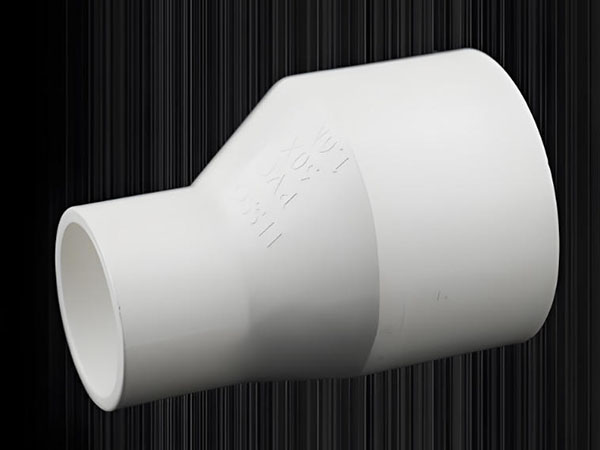
What are PVC eccentric reducers?
PVC (polyvinyl chloride) is a widely used thermoplastic. Its advantages include corrosion and chemical resistance, a smooth interior with low friction, excellent insulation, lightweight, easy processing and installation, and relatively low cost. These properties make it an ideal material for pipe and fitting manufacturing, particularly in drainage, water supply, and chemical transportation.
Reducer: As the name suggests, this is a pipe fitting used to connect two pipes of different diameters, commonly known as a “reducer.”
Eccentricity: This fundamentally distinguishes it from a “concentric reducer.” While concentric reducers have their centerlines aligned, eccentric reducers have their centerlines offset, meaning their two ends are not coaxial.
PVC eccentric reducers are connectors made of PVC with different diameters at their ends and an offset centerline. They typically feature a straight edge on one side and a beveled edge on the other.
The core difference between eccentric and concentric designs and why eccentric is the right choice.
Concentric reducers: When changing diameter, the centerline of the pipe remains unchanged. They are more suitable for gas or liquid transport systems (such as central air conditioning water systems and water supply pipelines). Their purpose is to reduce turbulence and energy loss during diameter changes, maintaining flow stability.
Eccentric reducers: Their flat side down design is the key. In industrial and residential drainage systems, water often carries solid impurities and bubbles. During installation, they are typically installed with the flat side down.
Preventing cavitation (Vapor Lock): Using an eccentric reducer (flat side down) at the pump inlet ensures that the top of the pipe remains level, preventing the formation of air pockets at the diameter change. Air pockets can obstruct fluid flow, reduce flow rate, reduce pump efficiency, and even cause cavitation damage to the impeller. Maintaining a straight bottom: For wastewater containing impurities such as solid particles and fibers, a straight-down installation ensures a continuous, unobstructed drainage channel at the bottom of the pipeline, preventing impurities from accumulating at diameter changes and potentially clogging the pipe.
Adjusting pipeline elevation: In complex pipeline installations, fine-tuning the pipeline height is often necessary to avoid obstructions or connect to other systems. Eccentric reducers provide a simple and effective solution.

Main Applications of PVC Eccentric Reducers
Building Drainage Systems: The most common application is at the junctions between horizontal main and branch pipes in high-rise buildings. They effectively prevent blockage and exhaust gas accumulation, ensuring smooth drainage.
Industrial Wastewater Treatment: PVC’s chemical resistance shines in corrosive wastewater discharge pipes from chemical, electroplating, and papermaking plants, while its eccentric design ensures smooth passage of suspended solids.
Pump Inlet/Outlet: As mentioned above, these reducers are installed at the front end of the pump inlet (usually on the suction side) to effectively prevent air accumulation, protect the pump, and improve efficiency.
Ventilation Systems: They are also used in ventilation ducts where diameter changes and pipe elevation adjustments are required.
Agricultural Irrigation and Drainage: They are used in integrated water and fertilizer systems and drainage ditches in large greenhouses and farmland.

Installation Precautions and Procedures
Orientation is crucial: In most cases, the “flat side down” principle should be followed to prevent the formation of air pockets and the accumulation of impurities. The “flat side up” installation method is only used in rare cases where fluid accumulation within the pipe must be removed (such as gas pipelines).
Cleaning and Inspection: Before installation, ensure the interior of the socket and spigot of the pipe and fittings are clean and free of impurities such as sand, sand, and oil. Check that the seals are intact and free of distortion.
Solvent Welding:
Cutting and Trimming: Use a dedicated cutter to cut the pipe to the desired length. Use a file or scraper to remove burrs and allow for thermal expansion and contraction.
Marking the Depth: Mark the depth of the socket on the spigot end as a guide for insertion.
Cleaning and Gluing: First, evenly wipe the inside and outside of the socket with a dedicated primer to remove oil and soften the PVC surface to facilitate fusion. After the cleaner evaporates, quickly and evenly apply the specialized PVC cement to the socket and spigot.
Insert and Secure: Quickly insert the spigot into the socket, rotating it a quarter turn to ensure even distribution of the glue, and insert it to the previously marked depth. Maintain pressure for 15-30 seconds to secure it. Wipe away any excess glue.
Curing Time: Depending on the ambient temperature and pipe diameter, keep the joint free of stress and allow it to stand for at least 30 minutes (refer to the glue instructions). Allow the glue to fully cure before conducting a water pressure test.
System Support: The piping system must be properly supported by brackets or hangers, especially around pipe fittings such as reducers, to avoid stress concentrations.
While PVC eccentric reducers may be a simple fitting, the fluid dynamics principles and practical value behind them cannot be underestimated. They exemplify the “small parts solve big problems” approach in modern piping engineering.


