

In the grand scheme of a high-density polyethylene (HDPE) piping system, the pipes themselves are the crisscrossing “highways,” while the fittings are the “transportation hubs” that ensure the efficient and orderly operation of the entire network. Reducers play a crucial role within this network—they bridge the gap between pipes of different diameters and are key to balancing flow and pressure. This article will delve into HDPE reducer sizes and provide a comprehensive guide to their selection and application.
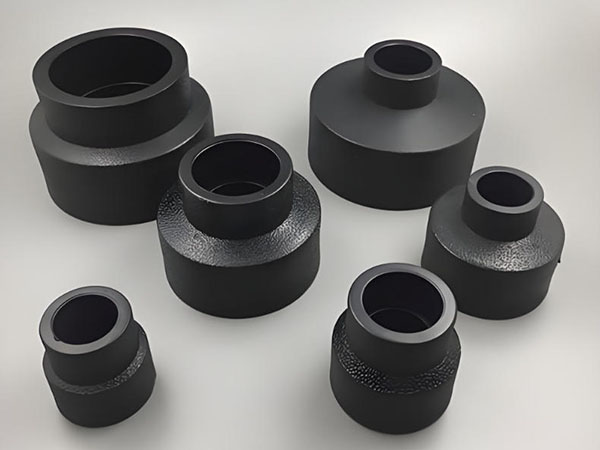
What is an HDPE reducer?
An HDPE reducer is a fitting used to connect two HDPE pipes of different outer diameters. Its primary function is to achieve a smooth transition between pipe diameters, thereby:
Optimizing fluid dynamics: Reducing turbulence, head loss, and energy consumption caused by sudden changes in pipe diameter.
Balancing system pressure: Where flow rates require change, system pressure is adjusted by changing pipe diameter.
Adapting to design requirements: Flexibly connecting pipes from trunk lines to branch lines and at equipment interfaces.

HDPE reducer size standards
To understand HDPE reducer sizes, one must first understand the core HDPE pipe standards: outside diameter control (OD-Control) and standard size ratio (SDR).
Outer diameter (OD):
This is the most fundamental dimension in HDPE piping systems. The size designation of a reducer is determined solely by the OD of the pipes at its ends. For example, a 110mm x 63mm reducer indicates that one end is designed to connect to a pipe with an OD of 110mm and the other end is designed to connect to a pipe with an OD of 63mm. Common HDPE pipe outer diameter series (unit: mm) include: 20, 25, 32, 40, 50, 63, 75, 90, 110, 125, 140, 160, 180, 200, 225, 250, 280, 315, 355, 400, 450, 500, 560, 630, etc.
Standard Dimension Ratio (SDR):
SDR = Nominal Outside Diameter / Nominal Wall Thickness. It is a dimensionless number that represents the pipe’s wall thickness grade and pressure-bearing capacity.
The smaller the SDR value, the thicker the pipe wall and the greater the pressure-bearing capacity; conversely, the larger the SDR value, the thinner the pipe wall and the lower the pressure-bearing capacity. Common SDR ratings include: SDR11, SDR13.6, SDR17, SDR17.6, SDR21, SDR26, SDR33, etc.
Importance: When selecting a reducer, ensure its SDR value matches the pipe it connects to. An SDR11 reducer must be used to connect to an SDR11 pipe to ensure consistent pressure ratings across the entire connection. Mixing fittings and pipes with different SDR ratings creates weak points in the system and is prone to failure.
Reducer Types and Dimensions:
Concentric Reducer: The two ports have the same centerline. This creates symmetrical flow lines when fluid passes through. It is primarily used in vertical piping systems to prevent the formation of air pockets.
Eccentric Reducer: The two ports have non-coincident centerlines but are offset and parallel. It is typically used in horizontal piping systems.
Flat Top (FT): Used in applications where air removal is required, such as pump inlets. Flat Bottom (FB): Used when draining a pipe or preventing contaminant buildup.
Length: The overall length of a reducer varies by manufacturer and specification, but the design ensures a smooth transition to minimize pressure loss.

How to choose the right HDPE reducer size?
Confirm the outer diameter and SDR of the existing pipe:
Use a caliper to accurately measure the outer diameter of the pipe and check the markings on the pipe to confirm its SDR rating. This is the only basis for selecting a reducer; do not rely on guesswork.
Determine the outer diameter and SDR of the target pipe to be connected:
Be clear about the branch pipe or equipment size you will be connecting the main pipe to.
Select the reducer type:
Vertical pipe: Select a concentric reducer.
Horizontal pipe: Select an eccentric reducer based on your needs.
To prevent air pockets, select top flush (FT).
To facilitate draining and prevent sedimentation, select bottom flush (FB).
Check the pressure rating:
Ensure the SDR of the reducer matches the SDR of the pipes at both ends to ensure the same pressure rating (PN) across the entire connection. For example, a PN16 pipe must be connected to a PN16 reducer.
Consider the connection method:
HDPE reducers are primarily integrated into pipes via butt fusion or electrofusion. Ensure the reducer you choose is compatible with your construction equipment and processes.

Main Applications
Municipal water supply and drainage systems: Connecting main pipelines with smaller-diameter community distribution pipes.
Industrial piping systems: In industries such as the chemical and pharmaceutical industries, they connect pipes of varying sizes for different process flows.
Gas transmission systems: Securely connect high-pressure main pipelines with low-pressure user pipes in pressure regulating stations or branch lines.
Agricultural irrigation systems: Connect main water supply pipes with branch pipes or drip irrigation lines in fields.
Mine tailings transportation: Adjust pipe diameter to terrain and pressure variations during long-distance transportation.
Although a small pipe fitting, HDPE reducers are essential “size adjusters” in HDPE piping systems. Sizing is crucial and directly impacts the efficiency, safety, and lifespan of the entire system.


