

In modern urban infrastructure development, water supply piping systems constitute a core component for safeguarding the safety of both residential and industrial water usage. An efficient and stable water supply system relies not only on the inherent quality of the piping materials themselves but—more critically—on the scientific selection and strategic placement of pipe fittings during the system design phase. As a specialized manufacturer of water supply pipe fitting solutions, Junrui is dedicated to providing global clients with high-performance piping and complementary fitting products, thereby facilitating the realization of safe, durable, and efficient water supply networks.
The Importance of Pipe Fittings in Water Supply Pipeline Design
In water supply systems, pipe fittings play a critical role in connecting, redirecting, branching, changing pipe diameters, and controlling fluid flow. A lack of proper design or errors in selection can lead to the following issues:
Increased risk of pipeline leakage
Loss of water pressure or unstable flow rates
Higher system maintenance costs
Reduced service life
Relevant studies indicate that connection points—where fittings are located—are often the most failure-prone areas within a piping system; therefore, the proper selection of pipe fittings is paramount to the reliability of the entire system.

Common Types and Functions of Water Supply Pipe Fittings
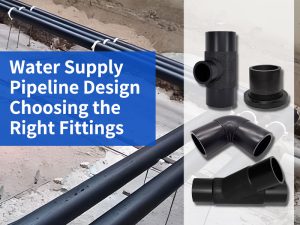
In water supply systems, various pipe fittings serve distinct functions. Common types include:
1. Elbows
Used to change the direction of water flow; common angles include 45° and 90°. They are suitable for use at building corners or within complex piping layouts.
2. Tees
Used to divert or combine flow, enabling the main pipeline to connect with branch piping systems.
3. Reducers
Used to connect pipes of different diameters, facilitating a smooth transition in flow rate and pressure.
4. Flanges
Used for connecting large-diameter pipes or equipment, facilitating ease of installation, disassembly, and maintenance.
5. Couplings
Used to extend pipelines in a straight line, thereby increasing the overall length and stability of the system.
Together, these pipe fittings construct a complete water transmission and distribution network within the supply system, serving as fundamental components essential for realizing the system’s functional capabilities.
Core Design Principles for Selecting Pipe Fittings
In the design of water supply pipelines, selecting appropriate pipe fittings requires a comprehensive consideration of multiple factors:
1. Pipeline Material Compatibility
Different pipe materials (such as PVC, PE, HDPE, stainless steel, etc.) require corresponding fittings made of compatible materials; otherwise, issues such as seal failure or chemical incompatibility may arise.
2. Working Pressure Rating
Pipe fittings must meet the system’s design pressure requirements. High-pressure water supply systems necessitate the selection of high-strength, pressure-bearing fittings to prevent pipe ruptures or leaks.
3. Characteristics of the Conveyed Medium
For potable water systems, it is essential to select non-toxic materials that comply with relevant hygiene standards; for industrial water applications, factors such as corrosiveness and temperature must be taken into account.
4. Installation Method and Construction Environment
Different connection methods (such as heat fusion, socket joining, flanging, threading, etc.) are suited to varying construction conditions. For instance, underground pipeline networks often favor heat fusion or socket connections to enhance sealing integrity and structural stability.
5. System Scalability
Modern water supply systems typically require long-term expansion capabilities; therefore, pipe fittings should feature excellent compatibility and standardized interface designs to facilitate future upgrades.
Analysis of Common Selection Errors and Associated Risks
In practical engineering applications, the improper selection of pipe fittings frequently leads to severe consequences:
Dimensional Mismatch → Results in stress concentration at connection points
Mixing of Materials → Triggers corrosion or accelerated aging
Substandard Fittings → Increases the probability of leakage
Failure to Account for Water Hammer Effects in Design → Causes shock-induced damage to the system
Therefore, during the engineering design phase, rigorous calculations and selection verification procedures must be strictly adhered to in order to ensure long-term operational safety.
Junrui Advantages in Water Supply Piping Systems
As a specialized manufacturer of plastic pipe fittings, Junrui offers comprehensive solutions for the water supply sector—encompassing the design and manufacturing of both piping and complementary fittings—and boasts the following key advantages:
Utilization of high-standard raw materials to ensure long-term system stability
Products that fully comply with international standards for water supply systems
Provision of customized solutions featuring a wide range of specifications and connection methods
Suitability for municipal water supply, industrial water supply, and agricultural irrigation systems
Rigorous quality inspection processes designed to minimize the risk of system leaks
Junrui remains steadfastly focused on enhancing the overall reliability of piping systems, thereby assisting clients in establishing safer and more efficient water supply networks.
In the design of water supply pipelines, the selection of fittings is not merely a matter of procuring accessories; rather, it constitutes a critical design phase that directly impacts the system’s performance and service life. Proper fitting selection necessitates a holistic assessment of various factors, including material properties, pressure requirements, fluid medium characteristics, installation methods, and future system expansion needs.
Through scientific design principles and the support of high-quality products—such as the piping and fitting systems provided by Junrui—it is possible to significantly enhance the safety, stability, and cost-efficiency of water supply networks, thereby providing a robust foundation for modern urban and industrial development.
FAQ
1. Why are fittings so important in water supply pipeline design?
Fittings connect and control the pipeline system, allowing direction changes, flow distribution, and diameter transitions. Poor fitting selection can cause leakage, pressure loss, and system failure.
2. How do I choose the right fittings for a water supply system?
You should consider pipe material compatibility, pressure rating, water quality requirements, installation method, and long-term system expansion needs before selecting fittings.
3. Can different pipe materials be connected using fittings?
Yes, but only with compatible transition fittings designed for different materials. Incorrect matching may lead to sealing issues or corrosion problems.
4. What types of fittings are most commonly used in water supply pipelines?
Common fittings include elbows, tees, reducers, couplings, and flanges, each serving specific functions like direction change, branching, or pipe size transition.
5. Why choose Junrui fittings for water supply systems?
Junrui provides durable, high-quality fittings designed for reliable sealing, long service life, and compatibility with various pipeline systems, suitable for municipal and industrial applications.


