

CPVC (chlorinated polyvinyl chloride) pipes and fittings are widely used in modern water supply and drainage systems and industrial piping. CPVC’s excellent corrosion and high-temperature resistance, coupled with its long service life, makes it a popular choice for hot and cold water piping, fire sprinkler systems, and some chemical fluid transport. To ensure the integrity and reliability of piping systems, appropriate CPVC fittings are crucial, not only for the pipe itself. Different types of CPVC fittings can perform various functions, including connection, diversion, diversion, and transition. This article systematically introduces common types of CPVC fittings to help users better understand and select the appropriate product.

Types of CPVC Fittings
CPVC Elbows
Elbows are one of the most common pipe fittings, used to change the direction of a pipe. CPVC elbows are primarily categorized as 90-degree elbows and 45-degree elbows.
90-degree elbows: Create a right-angle turn in the pipe and are widely used in applications with limited space.
45-degree elbows: Create a gentler turn in the pipe, reducing fluid resistance and suitable for systems with high flow loss requirements.
Edges typically have sockets at both ends, which are solvent-bonded to the pipe to ensure a watertight and pressure-resistant connection.
CPVC Tees
Tees are used to divide a main pipe into two branches or to join two branches into a single main pipe. Tees are categorized by their intended use:
Equal-diameter tees: Three openings have the same diameter and are commonly used for evenly branching pipes.
Reducing-diameter tees: Branch pipes have a smaller diameter than the main pipe and are suitable for diverting flow to ensure that the main pipe’s flow is not significantly affected.
CPVC Crosses:
Crosses have four openings and are shaped like a cross. This type of fitting is primarily used in piping layouts that require four-way flow diversion or merging. Because crosses have multiple stress points during installation, special attention must be paid to securing and supporting them when used in high-pressure or high-flow environments.
CPVC Coupling
Also known as a straight-through, a straight-through connection is used to connect two lengths of pipe of the same diameter. It features an internal bell-end design, allowing for a tight connection using adhesive. For ease of maintenance, a union can be used. This type of straight-through connection features a threaded structure that allows for removal without damaging the pipe.
CPVC Caps and Plugs
In piping systems, certain pipe openings need to be temporarily or permanently sealed. Caps or plugs are often used.
Caps seal the external end of a pipe and are typically bell-end designs.
Plugs insert into the internal threaded opening or bell end of a pipe fitting to provide a temporary seal.
CPVC Reducers
Reducing fittings are used to connect pipes of different diameters. Common types include reducing straights and reducing elbows. These fittings are crucial in water supply and fire protection systems, ensuring a smooth transition from the main to the branch, ensuring optimal fluid dynamics.
CPVC Adapters
Adapters are a type of fitting used for transitional connections. Common examples include:
Female Adapters: One end has a socket and the other has female threads, suitable for connecting to metal fittings or equipment.
Male Adapters: One end has a socket and the other has male threads, suitable for connecting to valves or metal fittings.
Adapters are frequently used in mixed systems, connecting CPVC to other pipe materials.
CPVC Saddle Tees
This type of fitting is used to create an opening in the sidewall of a pipe to allow for branch pipes. Its saddle-shaped design secures it to the main pipe, making it suitable for adding branch pipes without disconnecting the main pipe. It is often used in renovation projects or when temporary branch pipes are needed.
CPVC Valve Fittings
In addition to basic fittings, CPVC can also be made into valve fittings, such as ball valves and check valves.
Ball valves: Suitable for quick opening and closing, highly corrosion-resistant, and commonly used in water treatment and chemical applications. Check valve: prevents water from flowing back and protects the safety of equipment and pipelines.
CPVC Flanges
Flanges are used to connect pipes to equipment or different piping systems and are typically used with metal bolts. CPVC flanges can be divided into integral flanges and slip-on flanges. Gaskets are required during installation to ensure pressure resistance and leak-proof performance.
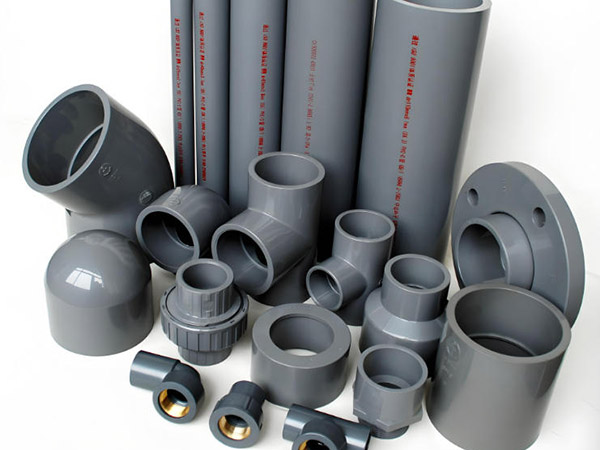
There are many types of CPVC fittings, including elbows, tees, crosses, straight connections, pipe plugs, reducers, joints, saddle tees, valves, and flanges. They play a key role in changing pipe direction, branching, connecting, transitioning, sealing, and controlling fluid flow. The appropriate selection and combination of these CPVC fittings not only improves piping system construction efficiency, but also extends its service life and ensures the safety and stability of the network. With the widespread application of CPVC in the construction, fire protection, and industrial sectors, the types and designs of CPVC fittings are constantly improving, providing more flexible and efficient solutions for modern piping projects.


