

PVC threaded coupling is a key component used to connect polyvinyl chloride (PVC) pipes, which can achieve quick sealing connection through internal and external threads. It is widely used in water supply and drainage, chemical industry, power and agricultural irrigation, and has the advantages of corrosion resistance, light weight and convenient installation. According to different functions, it can be divided into straight-through joints, tee joints, elbows and adjustable angle joints.
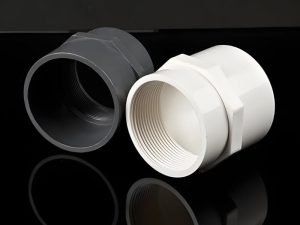
Types and structures of PVC threaded coupling
Standard straight-through threaded joints
It adopts internal thread (FPT) or external thread (MPT) design, suitable for connecting pipes of the same or different diameters.
Commonly used in water heating systems, it needs to be used with sealing tape or O-rings to ensure leakproofness.
Snap-on quick connector
It can achieve quick locking through the block and extension plate, reducing the cumbersome steps of traditional thread installation, and is suitable for temporary pipeline construction.
Adjustable angle joint
It adopts ball head and nut structure, allowing the pipeline to be freely adjusted in the range of 0°~90°, suitable for complex pipeline layout.
Tee joint
It has a built-in diversion channel and is equipped with valve control (such as block switch), which can flexibly open and close branch pipelines, and is commonly used in multi-way water supply systems.
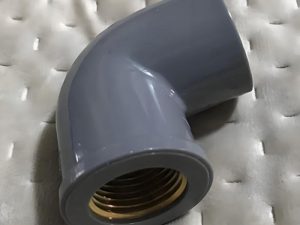
PVC lined steel pipe threaded joint
Combining the strength of metal pipes with the corrosion resistance of PVC, the thread tooth design optimizes the guide surface (35°~50°) to improve sealing and anti-sticking performance.
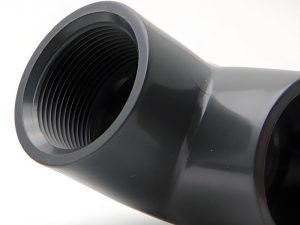
Manufacturing process and mold design
Injection molding
PVC particles are heated and melted and then injected into the mold. After molding, they are cooled and demolded. Key parameters include melt temperature (170°C~190°C) and injection pressure (80~120MPa).
Thread removal mechanism: The mold needs to be designed with a rotating ejector device to avoid thread damage.
Thread processing technology
Direct injection molding: The thread is molded in one time through a precision mold, which is efficient but the mold cost is high.
Mechanical cutting: Suitable for small batch production, with an accuracy of up to ±0.1mm.
Enhanced sealing design
The joint is embedded with a rubber pad (such as EPDM) or a buffer sealing layer is set to prevent fluid leakage.
PVC threaded coupling application scenarios and advantages
Municipal water supply and drainage
Acid and alkali corrosion resistant, life of more than 50 years, replacing traditional cast iron pipes.
Chemical pipelines
Suitable for the transportation of weakly corrosive media, such as acid and alkali solutions (pH 2~12).
Agricultural irrigation
The snap-on connector facilitates quick disassembly and assembly in the field, reducing labor costs.
Power cable protection
The socket-type connector simplifies the laying process and does not require bolt fixing.
Purchase and maintenance recommendations
Key indicators
Pressure level: SCH40 (1.0MPa) or SCH80 (1.6MPa).
Certification standards: in accordance with ASTM D2464 (threaded joints) or GB/T 10002.1 (PVC-U pipes for water supply).
Installation points
When wrapping the raw tape around the thread, it needs to be clockwise to avoid counterclockwise loosening.
The adjustable joint needs to lock the nut and check the integrity of the rubber sealing layer.
Maintenance strategy
Regularly check the corrosion of the thread. It is recommended to replace the seal every 2 years in chemical environments.
PVC threaded coupling has become a core component of modern piping systems due to its versatility and economy. In the future, with the advancement of material science and manufacturing technology, high-performance and intelligent joints will further expand their application boundaries. Users need to choose the adapter type according to the specific scenario and strictly follow the installation specifications to ensure long-term reliability.


