

Polyethylene pipes are widely used in agricultural irrigation, domestic water supply, landscaping systems, and low-pressure water supply projects due to their flexibility, corrosion resistance, and ease of installation. In these systems, insert fittings are key components for pipe connections, branching, and control.
This article will comprehensively introduce insert fittings for poly pipes from aspects such as structural principles, material classification, application scenarios, installation methods, and selection points, helping you to correctly understand and use this type of pipe fitting.
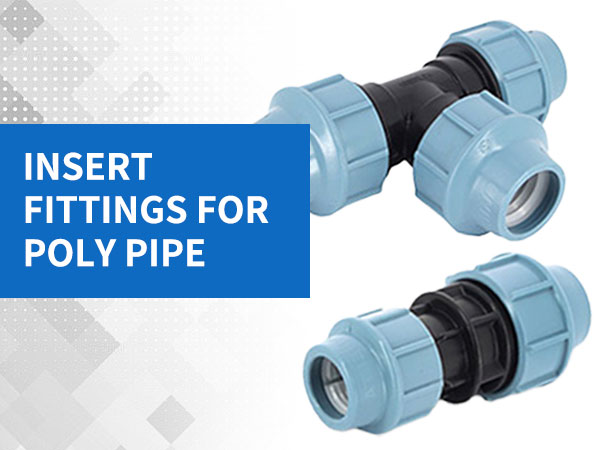
What are Insert Fittings for Poly Pipe?
Insert fittings are mechanical connection fittings specifically designed for connecting polyethylene hoses. They work by inserting the fitting’s insert end directly into the pipe, then tightening it with clamps or threads to achieve a reliable seal.
They are commonly used for:
LDPE/MDPE/HDPE pipes
Agricultural and garden irrigation systems
Low- or medium-pressure water supply systems
Compared to hot-melt welding, insert fittings require no specialized welding equipment, are quick to install, and easy to maintain, making them ideal for on-site construction and small-scale projects.
Basic Structure and Working Principle of Insert Fittings
1. Basic Structural Components
A typical insert fitting usually consists of the following parts:
Barbed Insert: Features multiple barbs or annular ridges to enhance friction with the pipe’s inner wall.
Body: Enables straight connections, elbows, tees, plugs, etc.
Locking Methods:
Hose Clamp:
Compression Nut:
External Thread Connection
2. Working Principle
When the insert is pushed into the polyethylene pipe:
Barbed Structure: The barbed structure prevents the pipe from coming out.
The elasticity of the pipe itself generates a radial clamping force on the insert.
Hose Clamp or Compression Nut: The clamp or compression nut further enhances sealing and tensile strength.
This “mechanical engagement + elastic sealing” method gives insert fittings good reliability in low and medium pressure systems.

Common Materials for Insert Fittings
1. Plastic Insert Fittings (Most Common)
Common materials include:
PP (Polypropylene)
Nylon (PA)
Advantages:
Lightweight
Corrosion and chemical resistance
Rust-free
Low cost
Ideal for irrigation systems and domestic water use
PP insert fittings are the mainstream choice in agricultural irrigation.
2. Brass Insert Fittings
Advantages:
High strength
High pressure resistance
Long service life
Disadvantages:
Higher cost
Heavier weight
May be susceptible to corrosion under certain water quality conditions
Commonly used in applications requiring higher mechanical strength or commercial applications.
Common Types of Insert Fittings
Depending on the connection method, insert fittings can be divided into several types:
Straight Coupling
Elbow (90° / 45°)
Tee
End Plug
Male Thread Adapter
Female Thread Adapter
Valve Insert Fittings
These fittings can be flexibly combined to meet the needs of complex piping layouts.

Application Scenarios
1. Agricultural Irrigation Systems
Drip Irrigation
Sprinkler Irrigation
Greenhouse Irrigation
Installation with plug-in fittings is quick and easy, ideal for large-area installations and frequent adjustments.
2. Landscaping and Gardening
Lawn Sprinkler Irrigation
Park Greening
Villa Garden Systems
3. Domestic and Temporary Water Supply Systems
Rainwater Harvesting Systems
Temporary Water Pipelines
Low-Pressure Water Supply Pipelines
4. Industrial and Aquaculture Sector
Aquaculture Water Supply
Simple Chemical Transportation (Non-High Pressure)
Installation Methods and Precautions
1. Standard Installation Steps
Cut the pipe
Ensure the cut is clean and burr-free
Soften the pipe tip (if necessary)
In low-temperature environments, soften the pipe with warm water
Insert the fitting
Push the fitting end fully into the pipe position
Secure and tighten
Use stainless steel clamps or glands to tighten
Pressure test
Check for leaks by running water
2. Installation Precautions
Installation depth must be correct
Clamps should not be too loose or too tight
Pipe size must strictly match the fitting
Not recommended for high-pressure or hot water systems (unless explicitly supported by the product)

Insert Fittings compared to other connection methods
| Comparison Aspect | Insert Fittings | Heat Fusion Welding | Electrofusion |
| Installation Speed | ✔ Very Fast | Slow | Relatively Slow |
| Removable | ✔ Yes | ✖ No | ✖ No |
| Tool Requirement | Minimal | Specialized Welding Machine | Specialized Equipment |
| Suitable Pressure | Low–Medium | Medium–High | High |
| Cost | Low | Medium | High |
How to Choose the Right Insert Fittings?
Key considerations during selection include:
Pipe material and outer diameter
Working pressure rating
Usage environment (indoor/outdoor/underground)
Water quality or media properties
Frequency of disassembly/reassembly required.
In agricultural and landscaping systems, matching appropriately sized PP insert fittings with high-quality polyethylene pipe is typically the most cost-effective solution.
Insert fittings for Poly Pipe, with their ease of installation, low cost, and high flexibility, hold an irreplaceable position in agricultural irrigation and low-pressure water supply systems. When correctly selected and installed according to specifications, they can provide stable and reliable connections.
For projects prioritizing construction efficiency, ease of maintenance, and system flexibility, insert fittings remain a very practical and mature connection solution for polyethylene piping systems.


