

PVC pipes are widely used in plumbing and electrical engineering due to their lightweight, corrosion resistance, low cost, and ease of installation. However, inaccurate measurement of PVC pipe dimensions can easily lead to mismatched fittings, leaks, or installation difficulties. Therefore, mastering the correct measurement methods is crucial for ensuring smooth piping system construction. This article will detail how to measure PVC pipe for fittings.
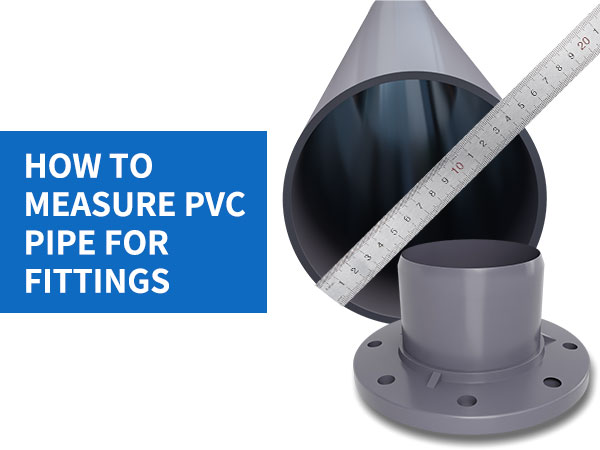
Understanding the Basic Specifications of PVC Pipes
Before measurement, it’s essential to understand several key specifications of PVC pipes:
Outer Diameter (OD): The outer diameter refers to the diameter of the pipe’s outer surface. It’s typically used to select insertion fittings, such as socket joints or clamps. Most PVC fittings are labeled with their matching outer diameter.
Inner Diameter (ID): The inner diameter refers to the diameter inside the pipe. It affects fluid flow rate and the tightness of fittings. While the inner diameter is often used to calculate water flow or pipe pressure, the outer diameter is more critical for fitting selection.
Wall Thickness/SDR Value (Standard Dimension Ratio): The wall thickness of a PVC pipe directly affects its pressure resistance. Different wall thicknesses may correspond to different fitting specifications. For example, Schedule 40 pipes and Schedule 80 pipes have different wall thicknesses; even with the same outer diameter, matching fittings are required.
Pipe Fitting Types: Depending on project requirements, commonly used pipe fittings include elbows, tees, reducers, and flanges. Different installation methods for pipe fittings (socket joints, glued socket joints, or threaded joints) have different requirements for measurement accuracy.
Tools for Measuring PVC Pipes
Accurate measurement of PVC pipes requires the following commonly used tools:
Vernier Calipers: Vernier calipers are the most precise measuring tools, suitable for measuring outer diameter, inner diameter, and wall thickness, with an error typically within 0.02mm.
Steel Measuring Tape: For large-diameter pipes (e.g., over 100mm), a steel measuring tape can quickly measure the outer diameter, but its accuracy is slightly lower than calipers.
Thickness Gauge: Thickness gauges are used to measure pipe wall thickness, especially for Schedule 80 or thick-walled pipes, facilitating the selection of pressure-resistant fittings.
Marking Pen and Ruler: Used to mark cutting lengths or insertion depths, ensuring correct fitting between fittings and pipes.

Steps for Measuring PVC Pipes
1. Measure the pipe’s outer diameter (OD)
The outer diameter is the most important dimension for selecting pipe fittings. The measurement steps are as follows:
Select a straight section of the pipe, avoiding bends or damaged areas.
Use vernier calipers to measure the diameter of the pipe’s outer wall. Measure at both ends of the pipe to ensure consistency.
For large-diameter pipes, use a steel tape measure to measure the outer circumference, then calculate the diameter using the formula:
OD = Circumference ÷ π
Note: Some PVC pipes are labeled with a “nominal diameter (DN),” not the actual outer diameter. The actual measured value may be slightly larger or smaller, requiring selection of fittings based on the actual measurement data.
2. Measure the pipe wall thickness
Pipe wall thickness affects the fit and pressure resistance of fittings:
Use a thickness gauge or vernier calipers to measure the pipe wall thickness.
Take the average value at multiple points along the pipe during measurement to avoid fitting problems caused by uneven pipe thickness.
For Schedule 40 and Schedule 80 pipes, the wall thickness differs, so even if the outer diameter is the same, corresponding fittings must be selected.
3. Measure Pipe Length and Cutting Depth
When selecting fittings, in addition to the diameter, the insertion depth or cutting length must also be determined:
Use a steel ruler or tape measure to measure the pipe length.
Mark the depth to which the pipe is inserted into the fitting. Generally, socket fittings have standard insertion lengths to ensure reliable bonding or sealing.
When cutting the pipe, keep the cut clean to avoid affecting the seal.
4. Consider Temperature and Expansion Factors
PVC pipes expand in high-temperature environments, so the temperature effect should be considered during measurement:
During summer construction, the pipe may expand slightly; allowance should be made for installation.
During winter construction, the pipe shrinks; the insertion length can be slightly shorter.
Common Measurement Problems and Solutions
Inconsistent Outer Diameter: Some PVC pipes may have production deviations. It is recommended to measure several pipes before selecting fittings to ensure compatibility.
Wall Thickness Deviation: Thick-walled pipes may cause difficulty in fitting insertion. Consider grinding the pipe end or selecting fittings of the appropriate size.
Difficulty Measuring Large-Diameter Pipes: For pipes larger than DN200, use a steel tape measure to measure the circumference and then calculate the diameter for higher accuracy.
Pipe Deformation or Scratches: Bending or damaged pipes may affect measurements. Select a straight, intact section for measurement.

Tips for Selecting Pipe Fittings:
Select fittings based on nominal diameter: PVC pipes are usually marked with a nominal diameter (e.g., DN50, DN100). When selecting fittings, prioritize the nominal diameter and then confirm the actual outer diameter through measurement.
Consider bonding or thread allowance: Socket fittings require allowance for bonding thickness, and threaded fittings require allowance for thread mating.
Use fittings from the same batch: Avoid installation problems caused by dimensional deviations between different batches of fittings.
Measuring PVC pipes to select appropriate fittings is a crucial step in ensuring the quality of pipe installation. Accurate measurements include pipe outer diameter, wall thickness, length, and insertion depth, while also considering temperature, pipe material, and construction errors. Proper use of vernier calipers, steel tape measures, and thickness gauges can significantly improve measurement accuracy. Mastering correct measurement methods not only ensures a tight fit between fittings and pipes but also prevents leaks, deformation, and later maintenance problems, providing reliable assurance for the safe operation of the pipeline system.
By following these steps and techniques, any PVC pipe installation project can achieve accurate dimensional matching, smooth construction, and safe use.


