

In a wide range of residential buildings, municipal water supply networks, industrial facilities, agricultural irrigation systems, and commercial developments, a stable and reliable water supply system is inextricably linked to the use of high-quality pipes and fittings. Many clients, after procuring their main pipelines, often overlook the critical importance of the accompanying fittings. In reality, components such as elbows, tees, couplings, flanges, and reducers directly impact the system’s leak-tightness, water flow efficiency, installation speed, and long-term maintenance costs.
As a specialized manufacturer of pipe fittings, Junrui is dedicated to providing global clients with comprehensive connection solutions for water supply projects. We assist our customers in quickly selecting the appropriate types, materials, and dimensions of fittings, thereby ensuring more efficient project installation and more stable system operation.
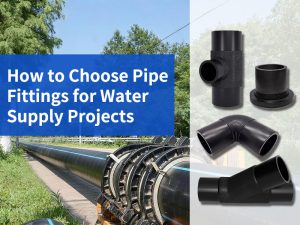
Why is the selection of pipe fittings critical in water supply engineering?
In practical engineering applications, pipe fittings fulfill vital functions such as connecting sections, changing direction, diverting flow, adjusting pipe diameters, and providing access points for maintenance. If selected improperly, the following issues may arise:
Joint leakage, compromising the stability of the water supply;
Mismatched pipe diameters, resulting in water pressure loss;
Incompatible materials, leading to a shortened service life;
Complex installation procedures, increasing labor costs;
Difficulties in future maintenance, disrupting system operations.
Therefore, selecting the appropriate pipe fittings is not merely a matter of procuring components; it is a crucial step in ensuring the long-term stability and reliable operation of the entire water supply system.

Common Types of Water Supply System Fittings
Junrui offers a wide variety of fittings commonly used in water supply systems to meet the diverse requirements of different projects.
1. Elbows
Used to change the direction of piping; common angles include:
45° Elbows
90° Elbows
Suitable for use at building corners, equipment connections, and in complex piping layouts.
2. Tees
Used to create branches off a main pipeline; can be categorized into:
Equal Tees
Reducing Tees
Suitable for water distribution across different floors or for connecting branch lines to specific supply zones.
3. Couplers
Used to create a straight-line connection between two pipe sections of the same diameter; one of the most frequently used connection components.
4. Reducers
Used to create a transitional connection between pipes of different diameters, facilitating a smooth change in pipe size within the system and minimizing water flow turbulence.
5. Flanges
Used for creating detachable connections, facilitating the maintenance and replacement of valves, pumps, and other equipment.
6. Caps / End Covers
Used to seal off reserved pipe outlets or to terminate the end of a piping system.
How to Choose the Right Pipe Fitting Material?
Different project environments require pipe fitting systems made of different materials.
Suitable for:
Municipal water supply
Underground piping systems
Agricultural irrigation
Long-distance water transmission projects
Advantages:
Corrosion-resistant
Lightweight
Strong sealing via heat fusion connections
Long service life
Suitable for:
Residential housing
Standard low-pressure water supply
Auxiliary drainage systems
Advantages:
Low cost
Easy installation
PPR Fittings
Suitable for:
Indoor hot and cold water systems
Home renovation projects
Internal water supply in commercial buildings
Metal Fittings
Suitable for:
High-pressure systems
Specialized industrial applications
Mechanical equipment connections
How to Select the Correct Pipe Fitting Size?
This is one of the most common questions asked by customers. Selecting the wrong size can easily lead to installation failure or a decline in system efficiency.
Basic Principle: The size of the pipe fitting must match the size of the main pipe.
For Example:
A DN20 pipe requires DN20 fittings.
A DN63 main pipe requires DN63 elbows or tees.
A DN110 main network requires DN110 connectors.
Common Size Ranges for Water Supply Projects
DN20 – DN32
Residential interior branch lines, home water supply systems.
DN40 – DN63
Small commercial buildings, floor-level water supply distribution.
DN75 – DN110
Medium-sized buildings, community water supply systems.
DN160 – DN315
Municipal main networks, industrial water supply systems.
DN355 and Above
Large-scale water transmission projects, urban main water supply lines.
How do you determine the appropriate size for a project?
Clients simply need to provide the following information, and Junrui can assist in quickly selecting the right specifications:
1. Project Type
Residential Buildings
Hotels
Schools
Factories
Municipal Water Supply
Agricultural Irrigation
2. Flow Rate Requirements
The higher the daily water supply volume, the larger the required main pipe size.
3. Pressure Requirements
High-rise buildings and long-distance water transmission projects require consideration of higher pressure ratings.
4. Installation Method
Underground Burial
Concealed Wall Installation
Exposed Piping System
Equipment Room Connection
What factors should be considered when selecting high-quality pipe fittings?
1. High Dimensional Accuracy
Ensures a tight fit during installation and minimizes the risk of leakage.
2. Stable Raw Materials
High-quality raw materials determine pressure resistance and service life.
3. Smooth, Defect-Free Surface
Prevents quality issues such as cracks, bubbles, and deformation.
4. Standardized Production
Complies with international standards, making it ideal for export projects and large-scale engineering works.
5. Comprehensive Supply Integration
Sourcing both pipes and fittings from a single supplier facilitates better system compatibility.
Why Choose Junrui?
As a professional manufacturer, Junrui provides comprehensive water supply pipe fitting solutions to clients worldwide:
Wide Range of Materials Available
Full Range of Sizes and Specifications
Stable Production Capacity
Rigorous Quality Control
Export Packaging and Logistics Support
OEM / ODM Services
Expert Project Selection Guidance
Whether you are an engineering contractor, distributor, wholesaler, or project procurement specialist, we are ready to provide efficient support tailored to your specific needs.
How Can We Help You Select the Right Products Quickly?
Simply provide us with the following information:
Project Country
Intended Water Supply Application
Pipe Material
Required Pipe Diameter
Pressure Rating
Quantity Required
Junrui will recommend the most suitable pipe fitting types, connection methods, and sizing specifications to help you reduce procurement costs and enhance installation efficiency.
In water supply engineering, selecting the right pipe fittings is just as critical as selecting the main piping itself. The appropriate materials, precise dimensions, and reliable connection methods determine the overall stability and service life of the entire system.
If you are looking for professional solutions for water supply pipe fittings, we invite you to contact Junrui. We are committed to providing your project with high-quality products and expert technical support for product selection.
FAQ
1. How do I choose the right pipe fittings for a water supply project?
Choose fittings based on pipe material, pipe size, pressure rating, installation method, and project application. Junrui can help recommend the best option.
2. What are the most common pipe fittings used in water supply systems?
The most common fittings include elbows, tees, couplers, reducers, flanges, and end caps.
3. How do I know which fitting size I need?
The fitting size should match your pipe outer diameter or nominal size to ensure proper connection and system performance.
4. Can different pipe materials use the same fittings?
Not always. HDPE, PVC, PPR, and metal pipes usually require compatible fittings designed for each material.
5. Which fittings are best for underground water supply lines?
HDPE fittings are widely used for underground systems because they are corrosion-resistant, durable, and leak-resistant.
6. Does Junrui provide custom sizes or OEM service?
Yes. We offer OEM/ODM production, customized sizes, and project-based supply solutions.
7. Can you help with complete project selection?
Yes. We can recommend suitable fittings, sizes, quantities, and matching pipe systems based on your project requirements.


