

HDPE vs. PVC Pipe Fittings for Water Supply – Which Is Better?
In the construction of water supply systems, the selection of pipe fittings is often overlooked; yet, in reality, it directly impacts the leak-tightness, durability, and safety of the entire piping network.
Currently, the two most common materials found on the market are HDPE (High-Density Polyethylene) fittings and PVC (Polyvinyl Chloride) fittings. So, when it comes to actual projects, which option is best suited for your specific water supply system?
In this edition of “Water Supply Pipe Fittings Solutions,” Junrui—a professional manufacturer of plastic pipe fittings—provides a comprehensive analysis spanning various dimensions, including performance, application scenarios, and cost. Our goal is to help you make a more informed and scientifically sound decision when selecting the right fittings for your project.
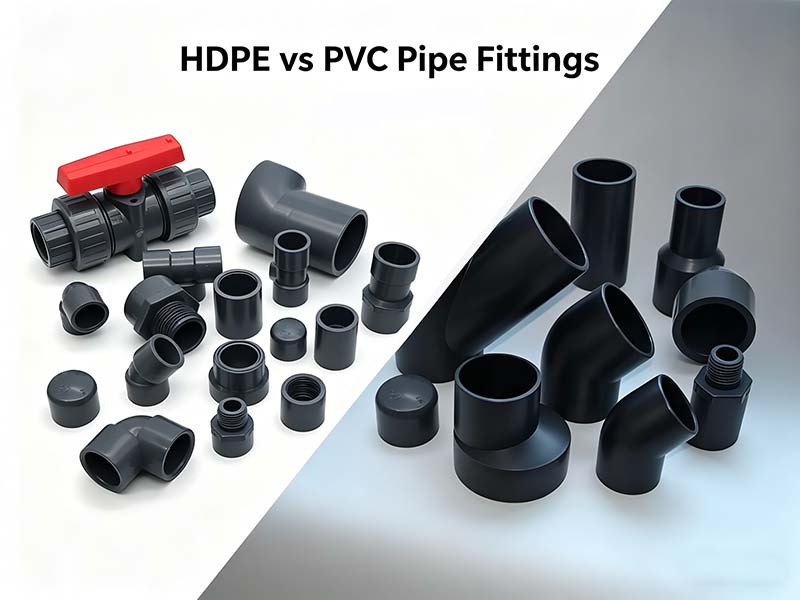
What Are HDPE and PVC Fittings?
HDPE (High-Density Polyethylene) fittings are plastic connectors characterized by their high flexibility and corrosion resistance; they are commonly used in fields such as water supply, gas distribution, and municipal engineering.
Key Features:
High flexibility
Excellent impact resistance
Suitable for heat fusion joining, offering superior sealing performance
2. PVC Fittings
PVC (Polyvinyl Chloride) fittings are rigid plastic connectors widely utilized in building water supply and drainage systems.
Key Features:
High hardness
Lower cost
Easy installation (via adhesive bonding)

Core Comparison: HDPE vs. PVC Fittings
1. Sealing Performance
HDPE Fittings:
Utilize thermal fusion connections (butt fusion / electrofusion), where the joint and the pipe fuse into a single entity, achieving a zero-leakage result.
PVC Fittings:
Typically employ adhesive or rubber ring connections; after prolonged use, there is a potential risk of aging or leakage.
Conclusion: HDPE is safer and more reliable, making it suitable for high-demand water supply systems.
2. Corrosion Resistance
HDPE:
Exhibits extremely strong resistance to acids, alkalis, and a wide range of chemical substances.
PVC:
While possessing a certain degree of corrosion resistance, its performance is slightly inferior in complex chemical environments.
Conclusion: HDPE is better suited for industrial applications or environments with complex water quality.
3. Impact Resistance and Flexibility
HDPE:
A flexible material capable of accommodating ground settlement without easily fracturing.
PVC:
A rigid material that is prone to becoming brittle and cracking in low-temperature environments.
Conclusion: HDPE is better suited for underground installations and complex geological environments.
4. Service Life
HDPE: 50 years or more.
PVC: 10–30 years.
Conclusion: HDPE offers a longer service life and lower maintenance costs.
5. Installation and Construction
HDPE:
Requires thermal fusion equipment; construction requirements are relatively high.
PVC:
Utilizes adhesive connections; installation is simple, and construction costs are low.
Conclusion: PVC is better suited for small-scale projects or situations requiring rapid construction.
6. Cost Comparison
HDPE: Higher initial cost, but more economical in the long run.
PVC: Lower initial cost, but may incur higher maintenance costs over time.
Conclusion: PVC is the preferred choice for short-term considerations, while HDPE is the better choice for the long term.
How to Choose for Different Application Scenarios?
Municipal Water Supply Systems
Recommended: HDPE Fittings
Reasons: High safety, long service life, no risk of leakage
Building Water Supply Systems
Recommended: PVC Fittings
Reasons: Low cost, ease of installation
Industrial Water Supply Systems
Recommended: HDPE Fittings
Reasons: Strong corrosion resistance
Agricultural Irrigation Systems
Recommended: PVC or HDPE
Limited Budget → PVC
Long-term Use → HDPE
Junrui’s Professional Recommendations
As a professional manufacturer of pipe fitting systems, Junrui recommends the following:
High-Standard Water Supply Projects → Prioritize HDPE Fittings
Budget-Sensitive Projects → Consider PVC Fittings
Complex Environments (Corrosion/Settlement) → HDPE is Essential
If you are unsure which solution to choose, we can provide customized selection recommendations tailored to your specific project.
HDPE or PVC — Which is Better?
There is no absolute “better” option—only the “more suitable” one.
Comparison Overview
| Evaluation Criteria | Better Choice |
| Sealing Performance | HDPE |
| Corrosion Resistance | HDPE |
| Impact Resistance | HDPE |
| Cost | PVC |
| Installation Convenience | PVC |
| Service Life | HDPE |
Overall Conclusion:
Long-term projects → Choose HDPE
Cost-sensitive projects → Choose PVC
About Junrui
Junrui is a manufacturer specializing in HDPE and PVC pipes and fittings, dedicated to providing high-quality water supply system solutions to clients worldwide.
We Offer:
HDPE Fittings
PVC Fittings
Customized Piping Systems
Technical Support and Product Selection Services
Contact Us for a Solution
If you are looking for a reliable supplier of water supply fittings, Junrui can provide you with:
Free Consultation
Project Solution Design
Rapid Quotation
Simply provide your project parameters, and we will match you with the optimal solution within 24 hours.
FAQ
Q1: Which is more suitable for drinking water systems: HDPE fittings or PVC fittings?
HDPE fittings are more suitable for drinking water systems.
Their heat fusion joining method creates a leak-free structure, while the material’s stability ensures it does not easily cause secondary contamination; consequently, they are widely used in municipal water supply projects.
Q2: Can PVC fittings be used in high-pressure water supply systems?
Yes, they can; however, it is necessary to select the appropriate specifications based on the required pressure rating.
In comparison, HDPE fittings are safer and more reliable in high-pressure environments, making them particularly suitable for main water supply networks.
Q3: Is the installation of HDPE fittings more complex?
Yes, it is. HDPE fittings typically require heat fusion equipment for joining, which places certain demands on construction techniques.
However, their advantage lies in forming a monolithic structure once joined, requiring virtually no maintenance in the long term.
Q4: What is the service life of PVC fittings?
Generally, it ranges from 10 to 30 years, depending specifically on the operating environment and the quality of installation.
If used in indoor settings or low-pressure systems, their service life tends to be longer.
Q5: How should one choose when working with a limited budget?
If the project budget is limited and requirements are not particularly demanding, PVC fittings may be a suitable choice.
However, for long-term projects or critical infrastructure, it is recommended to prioritize HDPE fittings to minimize long-term maintenance costs.
Q6: Which type of fittings should be chosen for industrial water systems?
HDPE fittings are recommended.
They possess superior corrosion resistance, enabling them to withstand complex chemical environments, and offer greater stability and reliability in operation.


