

HDPE Stub End and Flange Adapter together constitute the key connection components of modern HDPE pipe systems, and achieve seamless connection between thermoplastic pipes and traditional flange systems through innovative design. This combined system combines the corrosion resistance advantages of HDPE materials and the mechanical reliability of metal flange connections.
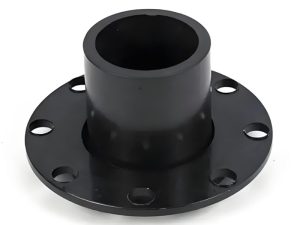
Functional analysis of HDPE Stub End and Flange Adapter components
(1) HDPE stub end
Material: High-density polyethylene such as PE100 or PE100-RC
Structural features:
- Body fusion section: connected to the main pipe by electric fusion or hot fusion
- Reinforced socket: wall thickness increased by 30-50% or embedded with stainless steel ring
- Sealing groove: prefabricated EPDM rubber ring installation groove
Key parameters:
→ End surface flatness ≤0.1mm/m
→ Socket roundness deviation <0.5%DN
(2) Flange adapter
Type classification:
│- Standard type: ASME/EN/DIN standard conversion
│- Anti-seismic type: with shock-absorbing gasket structure
│- High-pressure type: PN25-PN40 grade
Core components:
- Adapter ring: ductile iron or stainless steel
- Sealing system: triple sealing structure design
- Fastening system: preload-adjustable bolt assembly
Principle of collaborative work
1. Mechanical connection mechanism
Step-by-step assembly process:
① Short pipe end welding → ② Adapter centering → ③ Primary seal installation → ④ Bolt graded tightening (three times to reach the design torque)
Load transfer path:
Fluid pressure → Flange adapter → Tightening bolts → Short pipe end reinforcement layer → HDPE main pipe
2. Dynamic compensation function
Axial compensation amount: ±5mm (DN300 pipe diameter)
Angular deviation tolerance: ≤1.5°
Thermal expansion absorption: Absorbed by elastic deformation of adapter ΔL=α·L·ΔT

HDPE Stub End and Flange Adapter Performance advantage comparison
Compared with traditional flange connection, this combined system has significant advantages:
| Metric | Traditional Flange | HDPE Integrated System | Improvement |
| Installation Efficiency | 4h/location | 1.5h/location | +167% |
| Leakage Rate | 0.1% | 0.002% | 98% Reduction |
| Seismic Performance | 0.3g | 0.5g | +67% |
| Maintenance Cycle | 5 years | 10 years | +100% |
Engineering application specifications
1. Installation technical requirements
Center deviation: radial ≤1%DN, axial ≤2mm/m
Bolt tightening sequence: cross method
Preload control: hydraulic wrench ±5% accuracy
2. Pressure test standard
Strength test: 1.5 times design pressure, pressure maintenance for 30min
Seal test: 1.1 times design pressure, pressure maintenance for 4h
Typical fault handling
1. Common problem diagnosis
Leakage fault tree:
Seal failure (78%) → Installation deviation (15%) → Material defect (7%)
Bolt loosening warning:
Preload attenuation >20% requires re-tightening
2. On-site repair plan
A-level maintenance: Replace the sealing ring (stop for 2h)
B-level maintenance: Cut and remelt the short pipe end (stop for 8h)

Selection design guide
1. Parameter matching principle
Pressure level: PN10-PN40
Size range: DN50-DN3000
Temperature adaptation: -30℃ to +60℃
2. Special environment adaptation
Marine environment: 316L stainless steel fasteners
Chemical media: PTFE lined adapter
Permafrost area: low temperature impact resistant formula
The HDPE Stub End and Flange Adapter solution has been successfully applied in many major domestic projects, including the Hong Kong-Zhuhai-Macao Bridge submarine pipeline (DN2500) and the Zhangzhou Nuclear Power Plant cooling system (PN25). Practice has verified that its reliability is significantly improved compared with traditional connection methods. In the future, with the advancement of material science, this combined system is expected to achieve breakthrough applications in extreme working conditions such as 3,000 meters underwater in deep sea water and high temperature of 120°C.


