

High-density polyethylene (HDPE) pipe fittings are widely used in municipal, construction, agriculture, industry and other fields due to their excellent corrosion resistance, flexibility, long life and environmental protection. This article will systematically introduce HDPE fitting types, connection methods, application scenarios and selection recommendations to help users fully understand the HDPE pipe fitting system.

HDPE fitting types
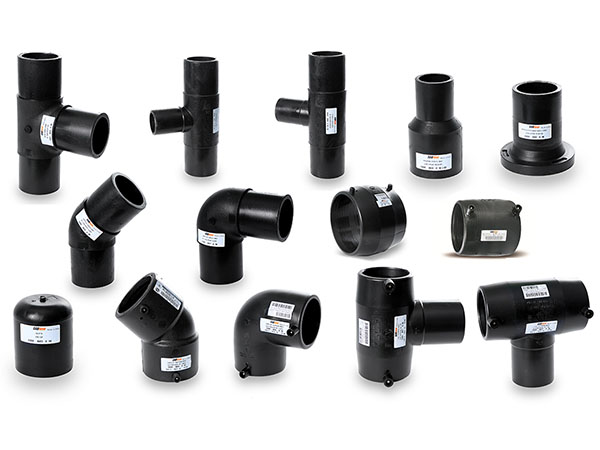
HDPE pipe fittings can be classified according to function, connection method, pressure level, etc. The following are common types:
1. Classification by function
(1) Connecting pipe fittings
Straight joint (equal diameter straight joint): used for straight connection of pipes of the same diameter.
Reducing straight joint (reducing pipe): connects pipes of different diameters (such as DN90 to DN63).
Tee (equal diameter/reducing diameter): used for diversion or confluence, such as T-type and Y-type tees.
HDPE Cross: used for multi-directional diversion, commonly used in complex pipe network systems.
Elbow (45°/90°): changes the direction of the pipe and reduces fluid resistance.
Flange joint: used for connecting HDPE pipes to metal pipes, valves or equipment.
(2) Pipe fittings for repair and plugging leaks
Pipe cap (end cover): seals the end of the pipe to prevent foreign matter from entering.
Paint joint: used for quick repair of damaged pipes.
Slip joint (quick disassembly joint): convenient for disassembling pipes during maintenance.
(3) Pipe fittings with special functions
Exhaust valve joint: used to remove air from the pipe to prevent air blockage.
Expansion joint: compensates for thermal expansion and contraction of the pipe to prevent deformation and cracking.
Manhole connector: used for sealing connection between HDPE pipe and manhole.
2. Classification by connection method
The connection method of HDPE pipe fittings directly affects the construction efficiency and sealing performance. Common types include:
(1) Hot-melt connection pipe fittings
Butt welding pipe fittings: suitable for large-diameter (DN≥90) high-pressure pipes, such as water supply and gas systems.
Socket welding pipe fittings: used for small-diameter pipes, with fast connection speed and good sealing performance.
(2) Electric fusion connection pipe fittings
Electrofusion sleeve: built-in resistance wire, which fuses with the pipe after being heated by electricity, suitable for emergency repairs or operations in narrow spaces.
Electrofusion flange: used to connect HDPE pipes to metal flanges.
(3) Mechanical connection fittings
Clamp-type fittings: no welding required, fastened with stainless steel clamps, suitable for temporary pipelines or non-pressure systems.
Threaded joints: used for small-diameter (DN≤63) low-pressure pipelines, such as household water supply and drainage.
3. Classification by pressure level
The pressure bearing capacity of HDPE pipe fittings usually matches the pipeline, common pressure levels:
PN6 (0.6MPa): suitable for low-pressure irrigation and drainage systems.
PN10 (1.0MPa): municipal water supply, industrial fluid transportation.
PN16 (1.6MPa): high-pressure water supply and gas pipelines.
Application scenarios of HDPE pipe fittings
1. Municipal engineering
Water supply network: Use electric melting or hot melting pipe fittings to ensure long-term sealing.
Drainage system: Use inspection well connectors, tees, etc. to build the network.
Gas transmission: Special pipe fittings that meet the GB 15558 standard must be used.
2. Agricultural irrigation
Drip irrigation system: Small-diameter (DN16-DN32) pipe fittings are matched with quick-connect connectors.
Sprinkler main pipeline: Use PN10 grade tees and elbows, which are resistant to high-pressure impact.
3. Industrial field
Chemical pipeline: Acid and alkali resistant pipe fittings (such as PE100 RC materials) are used to transport corrosive media.
Mine tailings pipe: Wear-resistant pipe fittings extend service life.
4. Building water supply and drainage
Indoor hot and cold water pipes: Use SDR11 series pipe fittings, which are resistant to -40℃~60℃.
Floor heating system: Oxygen-blocking pipe fittings prevent pipe oxidation and scaling.

HDPE pipe fitting selection guide
1. Material selection
PE80: suitable for low-pressure systems (such as drainage).
PE100: high strength, used for high-pressure water supply and gas.
PE100-RC: anti-cracking, suitable for trenchless construction.
2. Connection method selection
Construction conditions Recommended connection method
Large-diameter high-pressure pipes Hot-melt butt
Emergency repair or narrow space Electric fusion sleeve
Temporary pipes Clamp-type mechanical connection
3. Quality inspection points
Appearance inspection: no bubbles, cracks, impurities.
Dimension measurement: The inner diameter and wall thickness of the pipe fittings meet the standards.
Pressure test: 1.5 times the working pressure for 24 hours without leakage.
There are many types of HDPE fittings. Choosing the right type requires comprehensive consideration of factors such as pressure, medium, and construction environment. With technological advances, HDPE pipe fittings will replace traditional metal pipe fittings in more fields and become the core components of fluid transportation systems. It is recommended that users give priority to products that comply with ISO 4427 or GB/T 13663 standards to ensure engineering quality and long-term reliability.


