

HDPE compression fittings are key components used to connect HDPE (high-density polyethylene) pipes, mainly used in water supply, gas, industrial fluid transportation and other fields. Its core advantages include:
Quick installation: no need for hot melting or welding, suitable for emergency repairs and temporary pipe connections.
Detachable: convenient for later maintenance and system adjustment.
Corrosion resistance: suitable for acid and alkali environments, long service life.
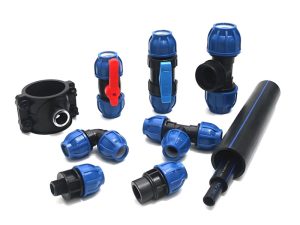
Main types and features
Material: polypropylene (PP), suitable for low-pressure systems (1.0-1.6MPa).
Size range: 20-110mm, thread specification 1/2″-4″.
Application: agricultural irrigation, temporary water supply for buildings.
(2) Stainless steel HDPE flange adapter
Material: 316 stainless steel, resistant to high pressure (PN16 and above).
Features: anti-corrosion, suitable for chemical and marine environments.
(3) Wire mesh skeleton HDPE composite pipe fittings
Structure: embedded steel wire reinforcement layer, pressure bearing capacity up to PN16.
Application: Municipal high-pressure water and gas pipelines.
Key performance parameters
| Parameter | Requirement | Test Standard |
| Pressure Resistance | ≥1.6 MPa (short-term) | GB/T 13663 |
| Sealing Performance | No leakage under 0.8 MPa water pressure | ISO 4427 |
| Chemical Resistance | No swelling or cracking after 30 days immersion | ASTM D543 |
| Environmental Adaptability | Stable performance from -40℃ to 60℃ | GB/T 8804.2 |
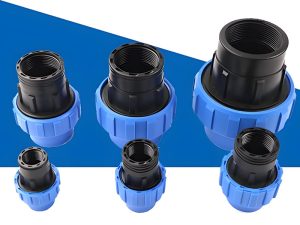
HDPE compression fittings application areas
Municipal engineering: rapid maintenance of water supply network and fire protection system.
Industrial pipelines: chemical fluid transportation and mine drainage.
Agricultural irrigation: branch pipe connection of drip irrigation system.
Gas transportation: PE100 grade compression fittings, certified by GB 15558.1.
HDPE compression fittings selection and installation guide
(1) Selection points
Matching pipes: confirm that the SDR value of the fittings is consistent with that of the HDPE pipe.
Certification standards: NSF/GB certification is required for water supply systems and GB 15558.1 is required for gas systems.
Supplier evaluation: enterprises with a monthly production capacity of more than 500,000 pieces (such as Zhejiang manufacturers) are preferred.
(2) Installation precautions
Seal inspection: 0.8MPa water pressure test is required after installation.
Anti-loosening measures: anti-stripping tape or anaerobic adhesive is required for threaded connections.
Environmental restrictions: avoid installation below -10℃ to prevent material brittle cracking.
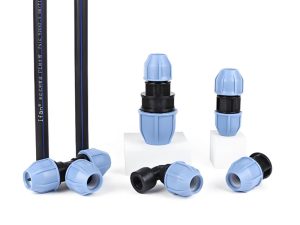
Typical problems and solutions
| Problem | Cause | Solution |
| Joint Leakage | Seal ring aging / not tightened | Replace EPDM seal ring or retighten bolts |
| Thread Stripping | Over-tightening or poor material | Use stainless steel threaded fittings, torque ≤ 50 N·m |
| Cracking in Low Temperature | Insufficient low-temperature toughness of HDPE | Use cold-resistant fittings (e.g., PE-RT material) |
HDPE compression fittings have become an important part of modern piping systems due to their convenience and reliability. Users need to choose the appropriate type according to specific working conditions.


