

In the global piping engineering, building water supply and drainage, and home renovation markets, PVC pipes and PEX (cross-linked polyethylene) pipes are very common pipe systems. With the increasing complexity of engineering scenarios and the growing frequency of cross-system construction, many users or purchasers raise a crucial question: Can you glue PVC fittings to PEX pipes?
The short answer is: No. Not only can you not glue them, but this practice poses extremely high risks in engineering projects and long-term use, including leaks, connection failures, failure to pass acceptance tests, and even system contamination or fire hazards (in high-temperature environments). This article will systematically analyze why gluing is not allowed, the potential hazards, and how to correctly and safely connect PVC and PEX in practical scenarios.

The fundamental principle of PVC adhesive bonding makes it incompatible with PEX.
1. PVC adhesive is not an ordinary adhesive, but rather a “solvent bond.”
PVC adhesive (Solvent Cement) works by dissolving the PVC surface with a chemical solvent, causing the surface molecules of the pipe and fitting to soften and fuse, forming a near-integrated bond after curing. Therefore, its applicability depends on:
Both the pipe and fitting must be made of PVC or CPVC;
The surface must be soluble in the solvent and undergo molecular fusion.
2. PEX belongs to the polyethylene system and is not dissolved by PVC adhesive.
PEX is cross-linked polyethylene, with a solvent-resistant surface, low surface energy, and cannot be bonded by PVC solvents. Therefore, even if the adhesive appears to be bonded, it is actually only “attached to the surface” and no molecular fusion has occurred. Once exposed to:
Water pressure changes
Temperature fluctuations
Mechanical tension or vibration
The bond will quickly fail.
Conclusion: The bonding mechanism of PVC adhesive is completely incompatible with the material properties of PEX, therefore, an effective bond cannot be achieved.

Five Major Risks of Directly Bonding PVC Fittings to PEX Pipes
1. Inevitable Leakage or Detachment
Due to the inability to form a solvent bond, the adhesive layer will gradually peel, become brittle, and crack, leading to:
Leakage
Joint detachment
Complete system failure
2. Failure to Pass Project Acceptance Inspection
PEX is commonly used in drinking water, underfloor heating, and high-standard building systems. Its installation requirements typically follow:
ASTM F1960 / F1807 / ISO 15875 standards
Soluble adhesive bonding is prohibited
Using adhesive to bond PVC fittings to PEX will be 100% considered non-compliant in legitimate projects and will fail acceptance inspection.
3. Accelerated Failure at High Temperatures
PEX is commonly used in hot water systems and can withstand temperatures above 90℃. PVC adhesives, however, will at high temperatures:
Further embrittlement
Loss of adhesion strength
Release of solvent residue
Leading to faster joint failure.
4. Potential Water Pollution
PVC adhesive contains chemical solvents (THF, MEK, etc.). If incorrectly used in a PEX system, the following may occur:
The solvent cannot evaporate; it comes into direct contact with the fluid; it affects drinking water quality; it produces unpleasant odors or potential health hazards.
5. Decreased System Reliability and Potential Safety Hazards
PEX pipes are flexible, while PVC fittings are hard and brittle. After adhesive bonding:
The joint has extremely weak impact resistance; it may break due to external forces; and it may even pose safety risks in fire-fighting or high-temperature environments.
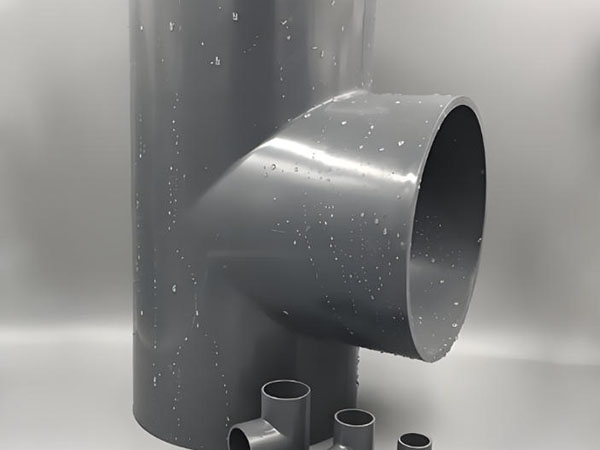
Why do users misunderstand the question “Can you glue PVC fittings to PEX pipe?”
This misconception usually stems from the following reasons:
| Misconception Source | Actual Situation |
| PVC glue is a “universal adhesive” | It is solvent-welding, only compatible with PVC/CPVC |
| Short-term bonding = success | PEX cannot be dissolved and fused, long-term failure is inevitable |
| Temporary DIY connection mindset in home projects | Mixing materials or glue connections are prohibited in engineering systems |
| Lack of understanding of surface energy differences | PEX is a low-surface-energy material, resulting in extremely weak adhesive bonding |
Therefore, what appears to be a simple adhesive bond is actually a structural error; it’s just a matter of time before it fails.
So how should PVC and PEX be correctly connected?
While glue cannot be used, PVC and PEX can be connected, but the correct transition scheme and mechanical connection method must be used:
1. Compression Adapter
Suitable Scenarios: Normal temperature or medium pressure water supply
Temporary transition in home renovations
Easy maintenance or replacement
Features: Connects PEX via a sealing ring and locking structure
Mechanical connection to PVC port (threaded/socket)
2. Crimp/Clamp Adapter
Suitable Scenarios: Transition of main water supply lines in buildings
Vibration or external force environments
Requires high sealing reliability
Features: Metal or engineering plastic ring clamps PEX
PVC end connects via thread or flange
3. Threaded Adapter
Suitable Scenarios: Pump rooms, water heaters, water tank outlets
Scenarios requiring disassembly and maintenance
Features: PEX end clamped/flared locking
PVC end threaded connection (no glue)
4. Expansion Fittings + PVC Threaded Fit
Applications: High-standard hot water systems, commercial projects
Features: PEX pipe flaring and locking, PVC ends with threaded or flanged fit

Comparison of the properties of PVC, PEX and CPVC materials
| Performance | PVC | CPVC | PEX |
| Temperature Resistance | Around 60 ℃ | 93 ℃+ | 90 ℃+ |
| Adhesive/Bonding Mechanism | ✔ Solvent welding (PVC glue) | ✔ CPVC-specific glue | ✖ Solvent glue bonding prohibited |
| Surface Solvent Reaction | ✔ Can be dissolved & fused | ✔ Can be dissolved & fused | ✖ Cannot be dissolved or fused |
| Flexibility | Low | Low | High |
| Corrosion Resistance | High | Higher | High |
| Installation Methods | Glue / Thread / Flange | Glue / Thread / Flange | Crimp / Expansion / Compression fittings |
Can you glue pvc fittings to pex pipe? It is clear from the material properties and construction mechanism that PVC glue cannot bond PEX, while solvent adhesives are suitable for bonding CPVC/PVC.
Choosing the right connection method is more important than simply whether it can be glued.
In engineering and home improvement, material transition connections must adhere to the following principles:
Material property compatibility
Construction mechanism compatibility
Reliable sealing structure
Compliance with local and international standards
Ensuring long-term operational stability
Any connection method that “seems feasible but is not permitted by standards” should be considered a potential source of engineering accidents.
PVC pipe fittings cannot be glued to PEX pipes, but they can be properly transitioned using compression, crimping, or threading methods.


