

In drinking water distribution systems, pipe fittings serve as critical components for ensuring water safety, system stability, and long-term operational reliability. Compared to standard industrial piping systems, drinking water systems impose far more stringent material requirements; they must not only guarantee structural integrity but also ensure that materials are non-toxic, non-contaminating, and do not adversely affect the taste of the water.
As a specialized manufacturer of plastic pipe fittings, Junrui is dedicated to providing high-quality fitting solutions tailored specifically for drinking water systems. Our product range encompasses various material systems—including PVC, CPVC, and HDPE—and is widely utilized in residential, municipal, and commercial water supply networks, as well as industrial drinking water systems.
Core Requirements for Fittings in Drinking Water Systems
When selecting fittings for drinking water systems, particular attention must be paid to the following key criteria:
1. Material Safety (Non-toxic & Safe)
The paramount principle of any drinking water system is safety. Fittings must comply with drinking water standards and must not leach harmful substances or compromise water quality. Certain high-grade PVC and CPVC materials have been certified as safe for use in drinking water distribution systems.
2. Corrosion Resistance
As drinking water may contain chlorine or trace chemical substances, fittings must possess excellent resistance to corrosion to prevent rusting, scaling, or contamination of the water source.
3. Long-Term Stability (Long Service Life)
High-quality drinking water fittings are typically designed for a service life of 30 to 50 years, ensuring the long-term, stable operation of the system and minimizing maintenance costs.
4. Water Quality Preservation
The materials used must remain chemically inert, ensuring they do not adversely affect the taste, odor, or clarity of the water.

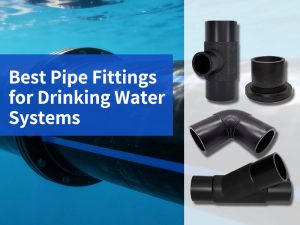
Best Pipe Fittings for Drinking Water Systems
In practical engineering applications, pipe fittings made from different materials are suited to specific drinking water environments. Junrui primarily offers the following three major categories of solutions:
1. PVC Pipe Fittings (Economical Drinking Water Solution)
PVC pipe fittings are among the most common materials for transporting drinking water, widely utilized in cold water systems and basic water supply networks.
Key Features:
Low cost and high cost-effectiveness
Easy installation and high construction efficiency
Smooth inner walls with minimal flow resistance
Suitable for low-pressure cold water systems
Applicable Scenarios:
Residential cold water supply systems
Community-level basic water supply networks
Irrigation and auxiliary drinking water systems
Note: PVC is generally not suitable for high-temperature hot water systems, as this may compromise its structural stability.
2. CPVC Pipe Fittings (The Preferred Choice for High-Security Drinking Water Systems)
CPVC is an advanced version of PVC; through chlorination modification, its heat resistance and chemical stability have been significantly enhanced. It is currently a widely adopted, premium choice for drinking water systems.
Core Advantages:
Withstands temperatures of up to approximately 93°C
Suitable for both cold and hot water systems
Strong corrosion resistance and resistance to scale buildup
Does not affect water quality and is odorless
Complies with drinking water safety standards
Applicable Scenarios:
Residential cold and hot water systems
Commercial building water supply systems
Hotel and hospital drinking water systems
Industrial pure water transport systems
Due to its high safety and stability, CPVC is widely regarded as one of the best choices for modern drinking water systems.
3. HDPE Pipe Fittings (Highly Durable Drinking Water Transport Systems)
HDPE (High-Density Polyethylene) pipe fittings hold a prominent position in municipal water supply and long-distance water transport systems, distinguished by their flexibility and impact resistance.
Key Features:
High impact resistance, suitable for complex terrain
Excellent flexibility, suitable for underground burial
Long service life (up to 50 years)
Strong resistance to chemical corrosion
Applicable Scenarios:
Urban main water supply networks
Long-distance water transport projects
Rural drinking water safety projects
Underground water supply systems
How to Choose the Right Drinking Water Pipe Fittings?
Junrui recommends making your selection based on the following four criteria:
1. Water Temperature
Cold Water Systems → PVC / HDPE
Cold & Hot Water Systems → CPVC
2. Water Quality Requirements
Standard Drinking Water → PVC / HDPE
High-Purity or Medical-Grade Water → CPVC
3. Pressure Rating
Low-Pressure Systems → PVC
Medium-to-High Pressure Systems → HDPE / CPVC
4. Installation Environment
Indoor Buildings → CPVC
Underground Networks → HDPE
Cost-Sensitive Projects → PVC
Common Types of Drinking Water Pipe Fittings
Junrui offers a comprehensive system of drinking water pipe fittings, including:
Elbows
Tees
Couplings
Reducers
Flanges
Valve Fittings
These fittings are perfectly compatible with PVC, CPVC, and HDPE systems, ensuring system leak-tightness and fluid stability.
Junrui Manufacturing Advantages
As a specialized manufacturer of pipe fittings, Junrui offers the following advantages within the field of drinking water systems:
Rigorous raw material selection to ensure compliance with drinking water safety standards
Precision mold manufacturing to guarantee dimensional stability
High-integrity sealing designs to minimize the risk of leaks
One-stop supply across multiple material systems (PVC / CPVC / HDPE)
Adaptability to engineering projects adhering to diverse global standards
In drinking water systems, selecting the appropriate pipe fittings not only impacts water supply efficiency but also directly relates to water quality safety and long-term operational costs.
A brief summary is provided below:
PVC Fittings: Economical and practical; suitable for low-pressure cold water systems
CPVC Fittings: Highly safe; suitable for both cold and hot drinking water systems (Recommended)
HDPE Fittings: Durable and reliable; suitable for municipal and long-distance water transmission systems
Junrui is dedicated to providing global clients with safe, efficient, and stable pipe fitting solutions for drinking water systems, ensuring that every drop of water reaches the end user safely.
FAQ – Best Pipe Fittings for Drinking Water Systems
Q1: What pipe fittings are safe for drinking water systems?
A: PVC, CPVC, and HDPE fittings produced under drinking water safety standards are commonly used. Junrui ensures all fittings are non-toxic and suitable for potable water applications.
Q2: Why is CPVC recommended for drinking water systems?
A: CPVC is highly resistant to heat and corrosion, making it ideal for both hot and cold drinking water systems. It also maintains water quality without affecting taste or odor.
Q3: Can PVC fittings be used for drinking water?
A: Yes, PVC fittings are widely used for cold drinking water systems due to their cost-effectiveness and stable performance, as long as they meet potable water certification standards.
Q4: What is the advantage of HDPE fittings in water supply systems?
A: HDPE fittings offer excellent flexibility, impact resistance, and long service life, making them ideal for municipal water networks and underground pipelines.
Q5: How do I choose the right pipe fitting material?
A: The choice depends on water temperature, pressure, installation environment, and project budget. CPVC is best for high-temperature systems, PVC for low-pressure cold water, and HDPE for large-scale distribution systems.
Q6: Are Junrui pipe fittings certified for drinking water use?
A: Yes, Junrui pipe fittings are manufactured under strict quality control and comply with international drinking water safety standards to ensure reliable and safe performance.


