

In the global pipeline connection system, 3-inch (DN80) pipe connectors are the standard connectors for medium and large pipeline projects. They are highly favored because of their strong versatility and wide range of applications. With the continuous investment in global infrastructure construction and the continuous advancement of plastic pipe technology, 3 inch pipe connectors made of PVC and HDPE have become the mainstream choice in the market. This article will deeply analyze the performance characteristics, application areas and global market performance of these two materials of 3-inch pipe connectors.

Basic specifications and global standards of 3 inch pipe connectors
The 3-inch pipe connector corresponds to a nominal diameter of 80 mm (DN80), which is a common specification in industrial pipeline systems. This size of pipe connector can meet most medium-flow transmission needs while maintaining relatively economical installation and maintenance costs. The International Organization for Standardization (ISO) and national standard organizations have clear regulations on the dimensional tolerances, pressure levels and other parameters of 3-inch pipe connectors to ensure global interchangeability.
The differences in international standards are mainly reflected in the pressure level classification and test methods. The European standard (EN) series usually divides 3-inch PVC pipe joints into three pressure levels: PN6, PN10, and PN16, while the American ASTM standard uses wall thickness series such as Schedule 40 and Schedule 80. HDPE pipe joints generally use the SDR (standard dimension ratio) system, such as SDR11, SDR17, etc., which represents the ratio of outer diameter to wall thickness.
In terms of connection methods, there are mainly the following types of 3-inch pipe joints:
Solvent bonding type: mainly used for PVC pipes, and permanent connection is achieved through special glue
Flange connection: suitable for high-pressure occasions, easy to disassemble and repair
Threaded connection: common in low-pressure small-diameter systems
Electric fusion connection: dedicated to HDPE, the material is melted and connected by heating
Mechanical compression connection: quick installation and reusable

Characteristics of 3-inch PVC pipe fittings
As one of the earliest industrialized plastic pipe materials, PVC (polyvinyl chloride) has the following significant characteristics:
In terms of physical properties, PVC pipe fittings have high rigidity and strength, and the pressure bearing capacity of 3-inch specifications is usually between 1.0-1.6MPa. Its heat deformation temperature is about 70-80℃, which is suitable for fluid transportation at room temperature. PVC material is hard and not easy to deform, and can maintain a stable shape for a long time after installation.
Chemical stability is the outstanding advantage of PVC pipe fittings. It has excellent corrosion resistance to most acid, alkali and salt solutions, and is particularly suitable for corrosive media transportation in chemical, electroplating and other industries. The non-conductive property of PVC also makes it an ideal choice for cable protection.
In terms of economy, the price of PVC raw materials is relatively low and the processing technology is mature, making 3-inch PVC pipe fittings very cost-effective. Its lightweight characteristics (density of about 1.4g/cm³) also greatly reduce transportation and installation costs.
However, PVC material also has some limitations: it is obviously brittle at low temperatures, so special care must be taken when using it in cold areas; it has poor weather resistance, and anti-UV agents need to be added for long-term outdoor exposure; it is flammable and produces toxic gases when burned, so it needs to be used with caution in places with high fire protection requirements.

Characteristics of 3-inch pipe connector made of HDPE
As a new generation of plastic pipe material, HDPE (high-density polyethylene) has different characteristics from PVC:
In terms of mechanical properties, HDPE pipe connectors have excellent toughness and impact resistance, and are not easy to crack even in low temperature environments. Its unique flexibility enables it to adapt to a certain degree of foundation settlement, and is particularly suitable for earthquake-prone areas and soft soil foundations.
It has outstanding chemical resistance and can withstand the erosion of a variety of strong acids and alkalis without electrochemical corrosion. HDPE has an extremely low water absorption rate (<0.01%), and its performance will not be affected by a humid environment.
Long service life is an important advantage of HDPE. Under normal use conditions, the design life of HDPE pipe connectors can reach more than 50 years, and the inner wall is smooth and scale-free, and the flow attenuation is small during long-term use.
The environmental protection characteristics of HDPE are also worthy of attention: the material is non-toxic and odorless, meets drinking water standards; it can be 100% recycled to reduce environmental burden; production energy consumption is about 20% lower than PVC, and the carbon footprint is smaller.
However, HDPE pipe fittings also have shortcomings: low rigidity, requiring more support points; limited high temperature resistance (usually not exceeding 60°C); the material is easily corroded by certain organic solvents; and the price is usually 20-30% higher than PVC.
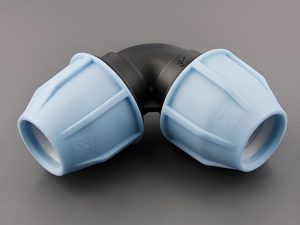
Comparison of global market applications
From the perspective of global market distribution, 3-inch pipe connectors made of PVC and HDPE have different focuses in different regions and fields:
Regional preferences:
North American market: HDPE is widely used, especially in the fields of water supply and gas
European market: The two materials are developed in a balanced manner, and environmental regulations promote the growth of HDPE
Asian market: PVC is dominant, with obvious cost advantages
Middle East: HDPE is more popular and adapts to high temperatures and harsh environments
Industry applications:
Municipal water supply: HDPE has gradually become the mainstream, especially in the field of large diameters
Building drainage: PVC still maintains its advantages, and cost and technical maturity are the key
Industrial pipelines: Select according to the characteristics of the medium, and HDPE is often used in corrosive environments
Agricultural irrigation: PVC occupies the main share, thanks to its price advantage
Mining transportation: HDPE is more wear-resistant and suitable for slurry transportation
Market trends show that in recent years, the growth rate of 3-inch pipe connectors made of HDPE has been higher than that of PVC, with an average annual growth rate of about 5.8%, while PVC is about 3.2%. This is mainly due to the promotion of environmental protection policies and the increased recognition of HDPE’s performance advantages. However, in price-sensitive markets and specific application areas, PVC will continue to maintain an important position for a long time.


